Abstract
Humanity currently navigates an era defined by the Anthropocene and the “polycrisis”—a complex, destabilizing web of interconnected ecological, social, and political emergencies. Concurrently, our primary mode of processing, debating, and governing these existential threats is mediated through the algorithmic infrastructure of digital platforms. This said, this paper synthesizes five distinct but deeply interconnected domains of contemporary scholarship to propose a novel theoretical framework: Digital Anthropocene Studies. By integrating theories of algorithmic curatorial assemblages, the interactive synopticon of live media, affective media practices in networked feminism, the macro-political sustainability trilemma, and the literary conceptualization of transcorporeality in the Anthropocene, this study argues that contemporary digital and political infrastructures attempt to address the polycrisis using the exact neoliberal and anthropocentric logics that created it. Digital platforms function as curatorial assemblages that commodify human affect, ranging from feminist outrage to deviant public disruption, into engagement metrics. This interactive synopticon traps public discourse in a reinforcement-amplification loop, characterized by lagged accountability and Eurocentric geopolitical realism. To transcend this metacrisis, we need to look beyond algorithmic feeds toward “trans-corporeal” narratives that reimagine the human condition not as a dominant, world-ending force (anthropos), but as a deeply entangled, ecological participant (homo). The present work offers a comprehensive paradigm for understanding how digital visibility, affective governance, and postcolonial intersectionality should evolve to foster genuine planetary survival.
-
Keywords: Affective Media Practices; Curatorial Assemblages; Interactive Synopticon; Polycrisis; Trans- Corporeality
The Metacrisis of the Digital Anthropocene
The contemporary human condition is caught in the crosshairs of two overwhelming hyper-objects: the geological reality of the Anthropocene and the ubiquitous, algorithmic infrastructure of the digital age. We are currently facing what scholars term a “polycrisis”—a system of multiple, interconnected crises, including climate change, rising inequalities, and democratic backsliding, where the combined impact of these emergencies creates a destabilizing effect far greater than any single crisis viewed in isolation (
Lovén, 2026). Yet, our primary mechanism for understanding, debating, and governing this polycrisis is mediated through social media platforms. These platforms are not neutral conduits of information; they are highly engineered environments that actively shape human behaviour, affect, and political reality. This said, this paper proposes a novel synthesis of media theory, political science, and ecocriticism to argue that our current digital and political frameworks are fundamentally ill-equipped to resolve the polycrisis because they rely on the same foundational logics that precipitated it. As
Lovén (2026) demonstrates in his critical discourse analysis of European Union Strategic Agendas, the foundational ideologies driving EU policy remain deeply rooted in market-centric, Western-dominated, and human-centric paradigms. These same logics are hardcoded into the algorithms of social media feeds, which prioritize economic value and engagement over social and environmental sustainability (
Bareither & Wirth, 2025).
To make these concepts actionable for policymakers, technology developers, and civil society, it is crucial to translate this critical theory into practical terms. When this paper refers to “curatorial assemblages” or “digital governmentality,” it is describing the everyday reality of how software design choices dictate public discourse. The algorithms governing our digital lives are not broken; they are functioning exactly as designed to extract profit from human attention, often prioritizing outrage over nuance, and shifting the burden of safety onto individual users rather than the tech companies themselves. To construct this framework, this paper adopts a transdisciplinary, critical synthesis methodology. Rather than conducting an exhaustive systematic review, we purposively selected five recent, foundational texts that represent the cutting edge of their respective fields—platform governance, affective media studies, macro-political sustainability, and ecocriticism. These specific works were chosen because they each uniquely diagnose the same underlying pathology of the polycrisis from different scalar perspectives, allowing us to map the homologous structures connecting micro-level algorithmic curation to macro-level geopolitical and ecological realities. While relying on a purposive sample of only five texts presents a methodological limitation in terms of breadth, this selection is not intended to serve as an exhaustive systematic review. Rather, these texts function as representative nodes within much larger disciplinary networks. By utilizing them as a heuristic device, this paper offers a theoretical provocation, an exploratory blueprint for “Digital Anthropocene Studies”, that future empirical research, broader literature reviews, and data-driven methodologies can test, expand, and refine.
When these neoliberal algorithmic logics intersect with human users, they create an “interactive synopticon” (
Aboubakar, 2026)—a digital environment where the masses watch the few, but with the added capacity to intervene, steer, and monetize real-time behaviour. This environment commodifies extreme human affect. Whether it is the mobilization of networked feminism and the negotiation of shame in the aftermath of the Mazan rape cases on TikTok (
Backes et al., 2025), or the monetization of deviant, norm-breaking public harassment in IRL (in-real-life) live streaming (
Aboubakar, 2026), the curatorial assemblage flattens moral valence into a single metric: engagement. To escape this algorithmic enclosure, we need to reimagine the human condition. Drawing on
Schoene’s (2024) analysis of the Anthropocene novel, this study argues that we must move away from the hubris of anthropos—the human as a destructive, world-altering geological force—and return to a “transcorporeal” understanding of homo, recognizing our deep, inextricable entanglement with the more-than-human world. By synthesizing these five critical perspectives, the current endeavour develops a comprehensive framework for understanding how affective media practices, platform governance, and postcolonial intersectionality should be radically restructured to survive the polycrisis.
The Architecture of the Crisis: Curatorial Assemblages and the Sustainability Trilemma
To understand how the public engages with global crises, we must first deconstruct the architecture of the digital spaces where this engagement occurs.
Bareither and Wirth (2025) conceptualize social media feeds (such as TikTok’s “For You” page or Instagram’s Explore feed) as “curatorial assemblages.” Drawing on the assemblage thinking of
Deleuze and Guattari (1987), as well as contemporary platform studies, they define these feeds as intricate digital ecosystems where human behaviour, interface design, data structures, and algorithmic processing are in constant dialogue. The primary function of this assemblage is curation—the deliberate filtering and organization of digital content designed to maximize platform utility and profit. However, the value generated within these digital ecosystems is inherently stratified.
Bareither and Wirth (2025) identify four distinct types of value produced by the feed: personal utility derived from content consumption, interpersonal status gained through visibility, financial profit extracted via ad targeting, and behavioral insights harvested for predictive modelling. While users actively seek experiential and social value, the platform’s ultimate, structural goal is the extraction of analytical and economic value. The recommender systems driving these feeds rely on collaborative and content-based filtering, creating a “tactile economy of attention” that demands continuous user interaction (
Bareither & Wirth, 2025). The interface itself acts as a curatorial agent, transforming human actions (scrolling, liking, and pausing) into machine-readable data that fuels the platform’s economic engine. This curatorial process is not entirely top-down; it is co-produced by users’ “algorithmic imaginaries”—their subjective understandings of how the feed works, which actively shape their explicit and implicit curatorial practices, such as tactical liking or strategic scrolling (
Bareither & Wirth, 2025). This algorithmic architecture mirrors the macro-political structures governing the global polycrisis.
Lovén (2026) utilizes the concept of the “sustainability trilemma” to show how political bodies like the European Union attempt to balance social equality, economic growth, and environmental protection. Through a rigorous critical discourse analysis (CDA) of the EU Strategic Agendas from 2014 to 2024, Lovén reveals a disturbing trajectory in institutional governance. The 2014-2019 agenda focused heavily on jobs and economic growth; the 2019-2024 agenda introduced a “green transition” but framed it strictly through an economic lens; and the 2024-2029 agenda pivoted sharply toward security, defence, and competitiveness, subsuming ecological priorities beneath the overarching goal of European economic dominance and market strength (
Lovén, 2026). Much like the curatorial assemblage of social media, EU policy is driven by a “green growth” paradigm that places market efficiency and financial growth above ecological preservation and social equity.
Lovén (2026) argues that this approach represents a “metacrisis”— a systemic failure rooted in the core ideological assumptions of modern society. The EU’s reliance on Eurocentrism and geopolitical realism reinforces a colonial logic of separation and hierarchy. It assumes European moral superiority while exploiting the Global South for the rare earth minerals required for its “green transition” (
Koch, 2025, as cited in
Lovén, 2026). When we synthesize
Bareither and Wirth (2025) with
Lovén (2026), a profound structural parallel emerges. The digital platforms that curate our understanding of the polycrisis are built upon the homologous, parallel structures of neoliberal, extractivist, and anthropocentric logic that drive the polycrisis itself, rather than being the exact same material processes. The social media feed extracts human attention and affect as a raw resource, just as the neoliberal state extracts natural resources. Both systems prioritize infinite growth (of engagement metrics or capital) over sustainable equilibrium. The EU’s strategic shift toward “preparedness” and “security” mirrors the platform’s shift toward algorithmic enclosure—both are defensive postures designed to protect economic value at the expense of holistic, planetary wellbeing. While comparing the micro-level algorithms of a video-sharing app to the macro-level geopolitical strategies of the European Union may initially seem like a massive leap of logic, this scalar jump is essential for understanding the polycrisis. The polycrisis does not respect disciplinary boundaries; it operates simultaneously across our screens and our ecosystems. The connection is not merely metaphorical, but structural. The exact same extractive logic that views the Global South’s minerals as infinite resources for European “green growth” also views human attention as an infinite resource for platform data extraction.
The Interactive Synopticon: Commodifying Deviance and Trauma
Within these curatorial assemblages, visibility becomes a highly volatile currency.
Aboubakar (2026) introduces the concept of the “interactive synopticon” to describe how live, monetized environments transform passive viewing into direct, real-time influence over offline events. Extending
Mathiesen’s (1997) synoptic configuration, which originally described mass media broadcasting where the many watch the few, Aboubakar argues that in the interactive synopticon, the traditional gaze is inverted and weaponized. Audiences do not merely watch passively; they use chat functions, paid text-to-speech (TTS) donations, and real-time metrics to actively steer the behavior of content creators in physical space.
Aboubakar’s (2026) analysis of “deviant IRL” (in-real-life) streaming, where creators stage public provocations and harassment for views, reveals the dark underbelly of the curatorial assemblage. Examining the critical cases of Vitaly Zdorovetskiy in the Philippines and “Johnny Somali” in Japan and South Korea, Aboubakar identifies three interlocking mechanisms that drive this phenomenon. First is Live Audience Steering, where remote viewers supply prompts and financing, effectively scripting offline disruptions. For example, Johnny Somali’s viewers paid via TTS to broadcast violent threats and looping baby-cry audio on a South Korean bus, altering the immediate real-world surroundings of bystanders while simultaneously providing the creator with a shield of plausible deniability. This dynamic creates a profound diffusion of responsibility, allowing the streamer to blame the interactive audience for offline harms while continuing to profit from the spectacle. Furthermore, this interactive synopticon is highly stratified; the ability to weaponize public space with relative impunity is heavily dependent on the streamer’s race, gender, and Western nationality (
Aboubakar, 2026). Because the interactive synopticon’s scoreboard registers intensity without moral valence, streamers are structurally incentivized to treat backlash and outrage as usable reinforcement, chaining together increasingly risky public disruptions to sustain attention density. Second is the Reinforcement-Amplification Loop. The platform’s interface (functioning as Bareither & Wirth’s curatorial assemblage) rewards “intensity without valence” (
Aboubakar, 2026). When Vitaly stole a bicycle in Manila, his cameraman narrated the rising viewer count (“Let’s break 5k, chat!”), translating real-world danger and the abuse of bystanders into a gamified pursuit of escalating metrics. A spike in outrage generates the exact same algorithmic amplification and economic reward as a spike in admiration. Ethical distinctions are erased, replaced entirely by the singular goal of increasing engagement statistics. Crucially, the mechanics of the interactive synopticon are not limited to deviant pranksters; they also govern how digital publics process trauma, justice, and activism.
Backes et al. (2025) explore this in their analysis of affective media practices on TikTok surrounding the Mazan mass rape trials in France, where Dominique Pelicot orchestrated the rape of his wife, Gisèle, by dozens of men over a decade. In response to this horrific systemic violence, networked feminists utilized the platform’s affordances to engage in what Backes et al. categorize as five key practices: feminist education, affective witnessing, iconization, shaming the perpetrators, and feminist cross-referencing. Through the lens of the interactive synopticon, we can see how the TikTok algorithm curated the Mazan case. Users engaged in the shaming of the perpetrators, utilizing green-screen effects to expose the men’s identities, seeking to redirect public stigma from the victim onto the abusers (echoing Gisèle Pelicot’s statement, “shame must change sides”). Furthermore, the iconization of Gisèle Pelicot—often depicted in stylized artwork wearing her signature sunglasses—framed her as a proud, unashamed heroine (
Backes et al., 2025).
However, as
Backes et al. (2025) note, this digital activism is a “double-edged sword” (
Larrain, 2023, as cited in
Backes et al., 2025). The platform’s curatorial assemblage thrives on the intense affective currency of outrage and disgust. While feminist creators successfully reclaimed narrative ownership, the algorithmic environment inherently individualizes systemic issues. The iconization of Pelicot redirects attention to her individual resilience, risking the obscuring of the broader patriarchal structures that enable rape culture. Nevertheless, we must be careful not to dismiss the real-world efficacy of this digital activism. Even as the platform flattens these values economically, the social impact of these practices remains highly distinct and profoundly consequential. The networked outrage surrounding the Mazan trials, while commodified by TikTok, successfully altered offline public discourse, challenged epistemic injustice, and mobilized tangible political pressure against rape culture. Furthermore, as
Backes et al. (2025) observe, this form of networked feminism operates within a highly polyphonic and fragmented digital environment. While affective media practices like visual shaming and feminist cross-referencing successfully challenge epistemic injustice, they simultaneously risk reducing complex socio-political interventions into fleeting, algorithmically optimized spectacles, demonstrating how the platform’s commercial logic can co-opt even the most profound demands for justice. On a related note, the practice of digital shaming often precedes legal verdicts, turning justice into a performative spectacle that aligns with the platform’s demand for high-arousal content. As
Backes et al. (2025) warn, this transforms online public shaming into a “digital pillory” that, while offering a form of vernacular justice, risks undermining principles of fair justice and ultimately fails to dismantle the deeper patriarchal structures of rape culture. In parallel, as
Ahmed (2004) notes, shame involves a double play of concealment and exposure; TikTok weaponizes this exposure for algorithmic gain.
While Western platforms commodify high-arousal exposure, the interactive synopticon manifests differently outside Western democratic contexts. In authoritarian regimes, for instance, the curatorial assemblage forces users to adopt entirely different affective strategies. As
de Kloet and Poell (2026) demonstrate in their study of WeChat in China, users navigating ubiquitous state surveillance and corporate dataveillance engage in “infrapolitics” and “discursive derailment.” Rather than relying on the high-arousal exposure seen in Western platform activism, Chinese citizens weave sensitive political critiques into mundane, everyday group chats, immediately following them with jokes or unrelated topics to obfuscate their meaning and evade algorithmic detection (
de Kloet & Poell, 2026). However, these hidden transcripts remain highly vulnerable. The increasing sophistication of state dataveillance and the imposition of strict liability regimes on group administrators have created a chilling effect, demonstrating that even the most obfuscated infrapolitics are susceptible to disruption and forced compliance (
de Kloet & Poell, 2026). This highlights how the curatorial assemblage can simultaneously function as an apparatus of digital authoritarianism and a site for hidden transcripts, forcing resistance to hide in plain sight.
Here, the synthesis of
Aboubakar (2026) and
Backes et al. (2025) reveals a profound paradox in digital governance: The curatorial assemblage flattens both deviant harassment and feminist activism into the same economic model of “reaction value” (
Davies, 2024, as cited in
Aboubakar, 2026). Whether an audience is paying a streamer to harass a bystander in Japan (Aboubakar) or sharing a viral video to shame a rapist in France (Backes et al.), the platform extracts analytical and economic value from the affective intensity of the interaction. The interactive synopticon commodifies disruption and trauma alike, creating an architectural reward system that transforms both offline abuse and the subsequent moral outrage into profitable content
Lagged Accountability and the Failure of Institutional Governance
If digital platforms and political institutions share the same neoliberal DNA, how do they attempt to govern the crises they exacerbate? The answer lies in the concept of “lagged accountability” (
Aboubakar, 2026), which scales from the micro-level of platform moderation to the macro-level of global geopolitics. In the realm of IRL streaming, lagged accountability means that streamers operate with relative impunity in the live moment, protected by the immediate financial rewards of the interactive synopticon. Sanctions only arrive after the fact, often driven by external public backlash rather than proactive platform governance. For instance, Vitaly was only arrested by the Philippine Bureau of Immigration after his clips went viral and sparked national outrage, at which point his self-documentation was reframed as evidence of wrongdoing (
Aboubakar, 2026). Furthermore, this impunity is unevenly distributed. As Aboubakar notes, Western male streamers operating in the Global South benefit from a “coloniality of infrastructure,” offloading the social and emotional toll of their stunts onto non-Western publics, all while funneling the resulting financial profits back into Western tech ecosystems. Johnny Somali, an American citizen, weaponized his nationality when confronted by authorities in Asia, highlighting how platform capital and Western mobility buffer creators from immediate consequences. Current legal frameworks, such as the European Union’s Digital Services Act (DSA), attempt to close this gap by mandating rapid response mechanisms for illegal content. However, according to our framework, the DSA ultimately fails to resolve lagged accountability because it remains reactive rather than proactive. It treats algorithmic harms as isolated incidents to be moderated post-facto, rather than addressing the foundational, engagement-driven business models that structurally incentivize such disruptions.
This micro-level digital colonialism perfectly mirrors the macro-level climate coloniality described by
Lovén (2026). The EU’s Strategic Agendas frame Europe as a “civilizational saviour” uniquely positioned to lead the fight against global warming. Yet, this Eurocentric discourse masks a geopolitical realism that prioritizes European security and competitiveness over global equity. The EU’s “green growth” strategy relies on the extraction of resources from the Global South, effectively lagging the accountability for environmental degradation. This is further exacerbated by an increasing securitization of the EU’s sustainability discourse, where social and environmental goals are increasingly squeezed by a geopolitical realist narrative focused on defending Europe and maintaining industrial competitiveness against external threats (Lovén, 2026). The Global South bears the immediate, devastating impacts of the climate polycrisis, while the Global North reaps the short-term economic and political rewards of the “green transition” (
Lovén, 2026). This displacement of systemic responsibility is not only geopolitical but also deeply domestic and interpersonal, manifesting in what
Milford (2026) terms “digital governmentality.” In her analysis of screen-time discourse and digital parenting, Milford illustrates how the failures of platform governance—such as the algorithmic amplification of extreme content and the commercial exploitation of attention—are routinely reframed as individual moral failings. Instead of holding platforms accountable for the harmful environments they curate, institutional guidelines and “technopanic” media narratives displace the burden of digital risk entirely onto families, trapping parents in a cycle of surveillance, guilt, and shame (
Milford, 2026). This dynamic establishes a moral economy of parenting that privileges individual vigilance over systemic accountability. By framing digital risk as a private moral challenge rather than a structural failure, technopanic narratives allow platforms to evade responsibility for their algorithmic amplification and data monetization strategies, forcing families to perform an impossible balancing act within a structurally imbalanced sociotechnical system. This burden of anticipatory governance is also profoundly gendered, disproportionately positioning mothers as the default moral guardians responsible for monitoring screen use and absorbing the emotional labor and societal shame associated with digital parenting (
Milford, 2026). Just as the neoliberal state externalizes environmental costs onto the Global South, the neoliberal platform economy externalizes the social costs of its curatorial assemblage onto the individual household, demanding that parents act as the sole regulators of a structurally imbalanced sociotechnical system.
Both the digital platform and the neoliberal state operate on a delayed clock when it comes to justice. They rely on postcolonial intersectional blind spots—ignoring how race, class, and geography dictate who suffers the immediate consequences of systemic disruption (whether it is a harassed service worker in an IRL stream or an exploited miner in the Global South). As
Lovén (2026) argues, addressing the polycrisis requires diagnosing these root causes rather than merely treating the symptoms. We cannot solve the metacrisis of anthropocentrism and Eurocentrism using the same geopolitical and algorithmic tools that enforce them. Because the polycrisis is fundamentally a crisis of imagination—a systemic failure to see beyond the extractive logics of both the state and the platform—we cannot rely solely on political science or media studies to find a way out. To bridge this massive gap, we must turn to disciplines that specialize in reimagining reality and human scale.
Trans-Corporeal Narratives: Reimagining the Human Condition
If the algorithmic curation of the interactive synopticon and the neoliberal policies of the state are insufficient to navigate the polycrisis, where do we turn for a new paradigm of meaning-making?
Schoene (2024) suggests that the answer lies in the realm of literature, specifically the Anthropocene novel, which possesses the unique capacity to recalibrate our understanding of the human condition.
Schoene (2024) critiques the instrumentalist view that literature must serve merely as an activist tool for climate change awareness (so-called “cli-fi”). Instead, he argues that novels like Martin
MacInnes’s In Ascension (2023) do something far more profound: they explore the psychological and existential impact of the Anthropocene on the individual. Drawing on Dipesh
Chakrabarty (2021), Schoene notes that the Anthropocene has fractured our understanding of humanity into two competing figures: the conscious, culturally situated person (homo) and the collective, unthinking geological driver of planetary destruction (anthropos). The digital curatorial assemblages described by
Bareither and Wirth (2025), and the geopolitical realism described by
Lovén (2026), are the ultimate manifestations of anthropos. They are massive, impersonal, algorithmic, and institutional forces that operate at a scale beyond individual human comprehension, driving the planet toward the “Great Filter”— the critical juncture at which a species develops the technological capacity to inadvertently orchestrate its own extinction (
Schoene, 2024). In MacInnes's novel, this hubris is represented by a massive corporate space mission aimed at escaping Earth, driven by the ecomodernist delusion that humanity can simply out-innovate its own extinction. The transition from critiquing hard socio-technical infrastructures to analyzing literary fiction is not a retreat from material reality, but a necessary epistemic intervention. Algorithmic enclosures thrive by reducing human behavior to machine-readable data, foreclosing alternative ways of imagining our relationship with the world. Literature, conversely, functions as a technology of the imagination. By providing a cognitive and affective bridge, literary meaning-making disrupts the datafied logic of the curatorial assemblage, offering the conceptual vocabulary required to envision the very systemic alternatives that algorithms are designed to obscure.
To counter the destructive ascent of anthropos,
Schoene (2024) introduces Stacy
Alaimo’s (2010) concept of “trans-corporeality”—the recognition that the human is always intermeshed with the more-than-human world, and that “the material world becomes the very substance of the self.” In In Ascension, the protagonist Leigh, a marine biologist, realizes while swimming in the ocean that “there was no gap separating my body from the living world... you could describe us as both people, and as mobile assemblages of ocean” (
MacInnes, 2023, as cited in
Schoene, 2024). This trans-corporeal epiphany shatters the anthropocentric illusion of human separation from, and superiority over, nature. Trans-corporeality offers a radical antidote to the logics of the polycrisis. While the interactive synopticon (
Aboubakar, 2026) alienates users from their physical environment by turning public space into a monetized digital stage, and while EU policy (
Lovén, 2026) treats nature merely as “natural capital” to be managed for economic growth, trans-corporeality demands a profound reintegration of the human into the ecological web. It aligns with the postcolonial intersectionality advocated by Lovén, challenging the Eurocentric, separational ontology that divides the world into binaries of civilized/uncivilized, human/nature, and subject/object. Furthermore, trans-corporeal narratives rescue the concept of “hope” from the neoliberal trap of infinite technological progress. In the Anthropocene, hope is often weaponized as a reactionary belief that humanity is “too big to fail” (
Colebrook, 2023, as cited in
Schoene, 2024) and that technological breakthroughs will save us from the polycrisis without requiring fundamental systemic change. This “species parochialism” stands in stark contrast to what David Chandler terms “nihilist hope”—an affirmative politics that accepts the end of traditional modernist progress and the absence of a guaranteed happy ending (
Schoene, 2024). However, true trans-corporeal hope—as depicted in the oceanic dissolution at the end of In Ascension, where Leigh accepts her return to the primordial waters—is found in the humble acceptance of our earthly belonging and our shared material vulnerability. This trans-corporeal reunion effectively resolves the Anthropocene’s fracturing of the human condition. By rejecting the ecomodernist fantasy of space colonization—driven by the blind, ruinous force of anthropos—and instead embracing our archaean descent, such narratives unground the human by forcing it back onto the earth. It is a radical planetary perspective that recognizes humanity not as the master of the environment, but as an inextricable, deeply implicated organ of the world itself. It is a rejection of the ecomodernist hubris that drives both space colonization and algorithmic surveillance capitalism.
Synthesizing a New Paradigm: From Algorithmic Enclosure to Planetary Entanglement
The synthesis of these five scholarly works reveals a comprehensive map of how humanity is currently failing to navigate the polycrisis, and how we might chart a new course. Currently, our response to global crises is trapped in a Curatorial Synopticon. We rely on digital platforms (
Bareither & Wirth, 2025) that empower interactive audiences to steer public behavior (
Aboubakar, 2026) and mobilize affective outrage (
Backes et al., 2025). However, because these platforms are built on the same neoliberal, anthropocentric, and Eurocentric foundations as our failing political institutions (
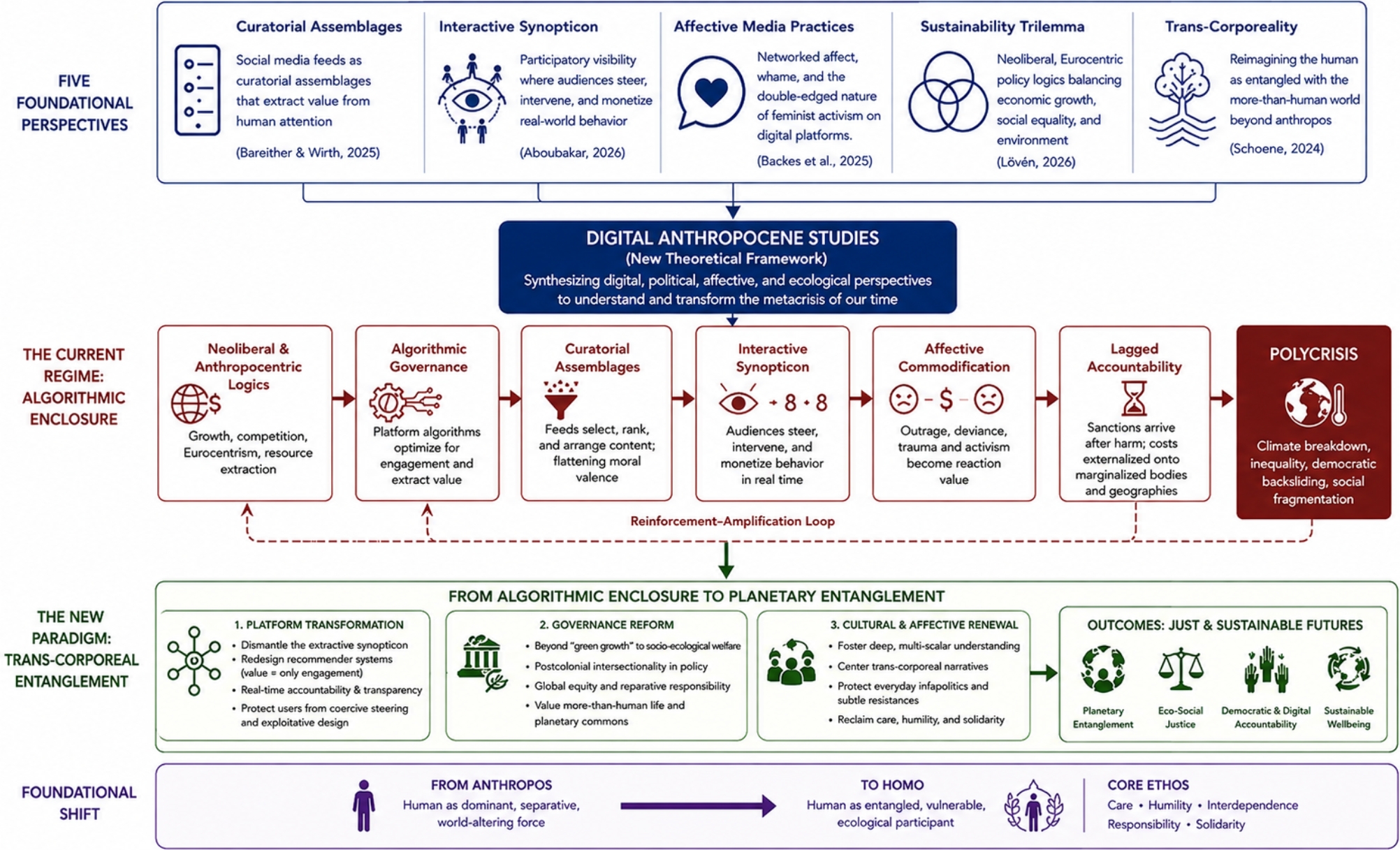
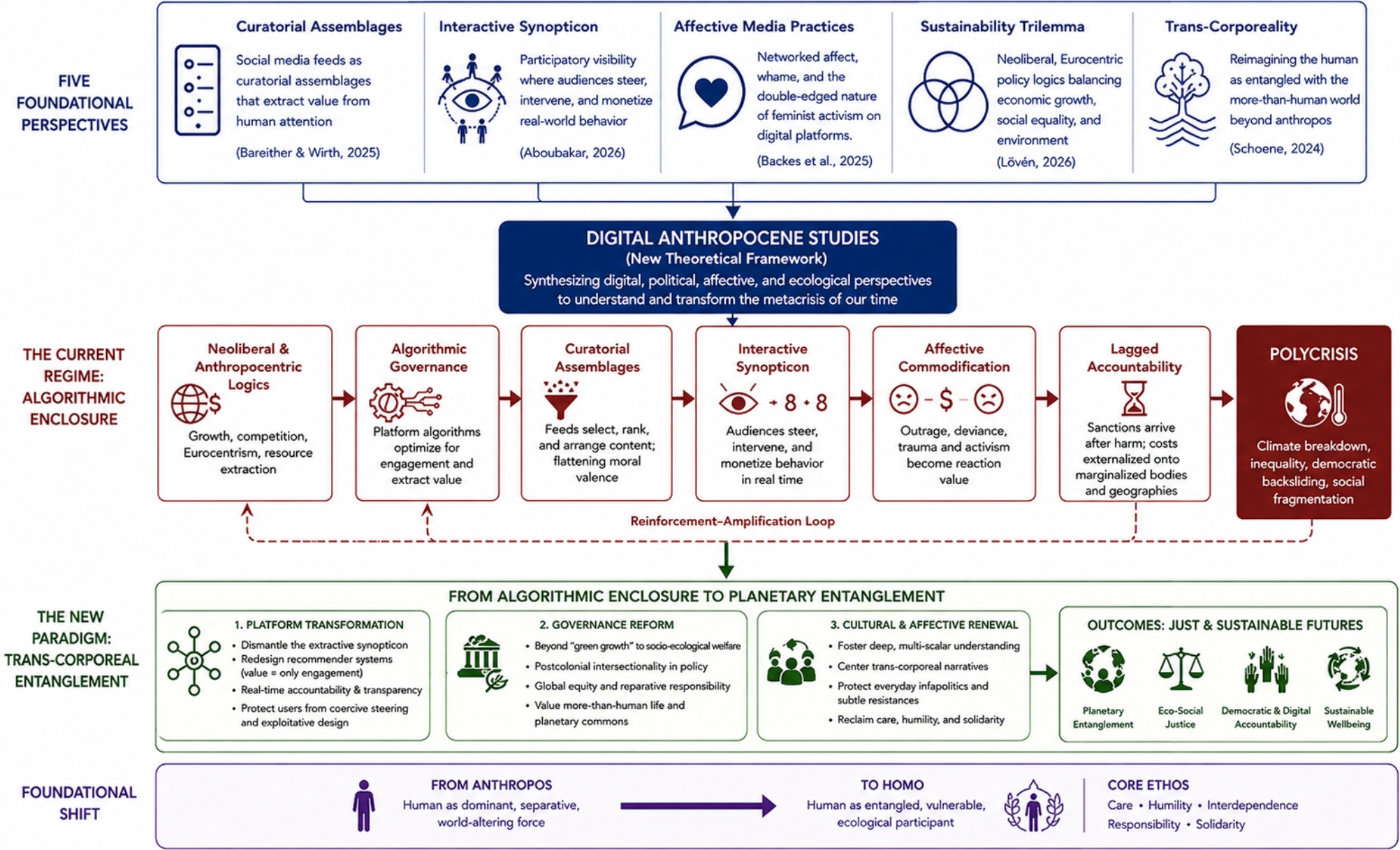
Lovén, 2026), they cannot produce genuine systemic change. They merely commodify our anxiety, trauma, and deviance, feeding it into a reinforcement-amplification loop that generates economic value for platform owners while externalizing the social and environmental costs onto marginalized bodies and geographies. To break this loop, we must shift our focus from algorithmic curation to Trans-Corporeal Meaning-Making. This requires interventions across three domains (See
Figure 1).
Policy and macro-governance: As
Lovén (2026) suggests, political bodies like the EU must abandon the “green growth” paradigm and geopolitical realism. Governance must be grounded in postcolonial intersectionality, recognizing that planetary wellbeing cannot be achieved through Eurocentric dominance or the continued exploitation of the Global South. Policy must shift from economic competitiveness to genuine eco-social welfare, recognizing the intrinsic value of nonhuman life. Given that both the state and corporate platforms are compromised by the pursuit of infinite growth, regulatory power cannot rely solely on top-down institutional enforcement. Instead, it must emerge from a coalition of transnational civil society organizations, digital rights advocates, and independent algorithmic auditing bodies. By establishing binding, multi-stakeholder governance frameworks—independent of direct state or corporate control—we can create the necessary friction to enforce these regulations. For policymakers and tech developers, this means moving beyond abstract ethical guidelines and implementing hard-coded structural changes. In plain language, this requires legally mandating transparent algorithmic impact assessments before new features are launched, enforcing chronological feed options as a default, and establishing independent oversight boards with the power to financially penalize platforms that fail to curb the algorithmic amplification of harmful content.
Platform architecture and micro-governance: As
Aboubakar (2026) and
Bareither & Wirth (2025) imply, we must redesign the affordances of digital platforms. We must dismantle the interactive synopticon by introducing friction into systems that reward coercive disruption (e.g. throttling abusive TTS) and by rethinking recommender systems that treat all affective engagement as equal value. In practice, a “trans-corporeal” platform affordance would involve algorithmic friction that distinguishes between civic mobilization and abusive harassment. For example, platforms could implement “contextual velocity limits” that temporarily pause the algorithmic amplification of rapidly trending, high-arousal content until it undergoes human-in-the-loop moderation, thereby mitigating the spread of deviant harassment without permanently silencing grassroots activism. Furthermore, policy regulation could mandate the integration of participatory design frameworks, allowing marginalized communities to co-author the safety guardrails of the algorithms that govern their digital spaces. Platforms must be held accountable in real-time, closing the gap of “lagged accountability” that allows digital colonialism to flourish. Furthermore, as
Milford (2026) argues, this accountability must shift the burden of digital wellbeing away from household-level vigilance and parental scapegoating toward systemic, co-designed platform regulation that recognizes the complex, relational realities of everyday digital life.
Cultural narratives and affective practices: As
Backes et al. (2025) and
Schoene (2024) demonstrate, we must elevate narratives that foster deep, multi-scalar understanding over fleeting, memetic iconization. While digital affective witnessing can spark solidarity, it must be anchored in the deep, trans-corporeal realization of our shared material existence. Literature and art must continue to bridge the gap between the intimate psychobiography of homo and the terrifying scale of anthropos, reminding us that we are not masters of the Earth, but “mobile assemblages of ocean” (
Schoene, 2024). Simultaneously, we must recognize and protect the subtle, everyday forms of digital resistance—the “infrapolitics” and discursive derailments (
de Kloet & Poell, 2026)—that marginalized and surveilled populations use to survive and maintain agency within these oppressive algorithmic architectures. This necessitates navigating a critical tension in our proposed paradigm: the demand for platform accountability versus the protection of everyday infrapolitics. If platforms become totally transparent and perfectly moderated, the very opacity that allows marginalized users to hide their resistance from authoritarian algorithms is destroyed. Therefore, “transparency” must be redefined not as the total surveillance of the user, but as the radical legibility of the algorithm itself—ensuring that users understand how they are being curated, while preserving their right to digital obscurity and tactical evasion.
Conclusion
The polycrisis of the 21st century is not merely an environmental or economic emergency; it is a profound crisis of meaning, governance, and human identity. As this manuscript has demonstrated, attempting to solve the polycrisis through the neoliberal, algorithmic frameworks of the digital age is akin to addressing a fire with gasoline. The curatorial assemblages of social media feeds (
Bareither & Wirth, 2025) and the interactive synopticon of live platforms (
Aboubakar, 2026) commodify human affect and deviance (
Backes et al., 2025), trapping us in a cycle of lagged accountability and structural inequality. By synthesizing the critical insights of platform governance, affective media studies, macro-political sustainability (
Lovén, 2026), and Anthropocene literature (
Schoene, 2024), we uncover the urgent need for a paradigm shift. We must reject the anthropocentric and Eurocentric logics that separate us from the natural world and from each other. Instead, we must embrace a trans-corporeal, intersectional understanding of the human condition—one that recognizes our inextricable entanglement with the Earth and demands a radical restructuring of both our digital infrastructures and our global political agendas. Only by coming back down to earth, and dismantling the curatorial synopticon that distorts our reality, can we hope to navigate the polycrisis and forge a sustainable, equitable future.
Notes
Figure 1.The Proposed New Paradigm
REFERENCES
- Aboubakar, H. (2026). The interactive synopticon: Participatory visibility and public disruption in IRL live streaming, New Media & Society. Advance online publication. https://doi.org/10.1177/14614448261453299
- Ahmed, S. (2004). The cultural politics of emotion. Routledge.
- Alaimo, S. (2010). Bodily natures: Science, environment, and the material self. Indiana University Press.
- Backes, A., Lünenborg, M., & Schankweiler, K. (2025). Shame must change sides: Affective media practices and the Mazan rape cases on TikTok. Media, Culture & Society, 48(2), 304–323. https://doi.org/10.1177/01634437251380413
- Bareither, C., & Wirth, S. (2025). Social media feeds as curatorial assemblages: A conceptual framework. Media, Culture & Society, 48(1), 73–88. https://doi.org/10.1177/01634437251360372
- Chakrabarty, D. (2021). The climate of history in a planetary age. University of Chicago Press.
- Colebrook, C. (2023). Who would you kill to save the world?. University of Nebraska Press.
- Davies, W. (2024). Reaction value: Affective reflex in the digital public sphere. Distinktion: Journal of Social Theory, 25(3), 297–317.
- de Kloet, J., & Poell, T. (2026). Why the everyday is essential: Navigating censorship and surveillance on WeChat in China. Media, Culture & Society. 48(2) 229246). https://doi.org/10.1177/01634437251380415
- Deleuze, G., & Guattari, F. (1987). A thousand plateaus: Capitalism and schizophrenia. University of Minnesota Press.
- Koch, M. (2025). Europe in the Postgrowth Era: Towards a Sustainable Welfare Deal. Journal of Common Market Studies, 63, 1665–1684. https://doi.org/10.1111/jcms.13728
- Larrain, B. (2023). Online public shaming as a feminist practice for social change, a double-edged sword for fighting gender violence: The case of the ‘feminist funa’ in Chile. Feminist Review, 135(1), 80–97.
- Lovén, V. (2026). Addressing the polycrisis with the same logic that created it? A critical analysis of sustainability discourses in the EU strategic agendas between 2014 and 2024. Contemporary European Politics, 4(2), e70043. https://doi.org/10.1002/cep4.70043
- MacInnes, M. (2023). In ascension. Atlantic.
- Mathiesen, T. (1997). The viewer society: Michel Foucault’s “Panopticon” revisited. Theoretical Criminology, 1(2), 215–234.
- Milford, S. C. (2026). Between guidelines and guilt: Parenting through the chaos of screen-time discourse. Media, Culture & Society, 48(4), 829–838. https://doi.org/10.1177/01634437251400650
- Schoene, B. (2024). Coming back down to Earth: The novel and the human condition in the Anthropocene. English Studies, 105(4), 587–605. https://doi.org/10.1080/0013838X.2024.2330827