Abstract
This article examines the temporal structure of state-seeking nationalist mobilization in the modern world-system. Scholars of nationalism have long debated whether nationalism expands with modernization, declines after reaching a historical peak, recurs in successive waves, or remains contingent on specific political conjunctures. Yet these competing temporal assumptions are rarely examined systematically. This article introduces polynomial regression analysis as a post-positivist heuristic method for making such assumptions visible and comparable. Rather than treating polynomial regression as a device for mechanically confirming or falsifying theories, it uses it as a diagnostic tool that clarifies how different interpretations become plausible under different specifications of time, geography, and periodization. Using the State-Seeking Nationalist Movements dataset, which tracks mobilization by stateless nations from 1492 to 2013, the article compares linear, quadratic, and cubic specifications across historical and geographical scopes. The findings show that linear, arc-shaped, and cyclical interpretations each capture partial dimensions of the historical trajectory. In the Global North after 1800, state-seeking nationalism appears as a secular increase, postwar decline, and renewed wave depending on model specification. At the world-systemic level, however, the inclusion of the Global South shifts the timing and form of decline.
-
Keywords: Nationalism; State-Seeking Movements; World-System; Polynomial Regression; Temporal Structure; Historical Sociology
Introduction
Scholars of nationalism have long debated the causes and consequences of nationalist mobilization in the modern world-system (
Anderson, 1991;
Deutsch, 1953;
Gat & Yakobson, 2013;
Gellner, 1983;
Hobsbawm, 1992;
Wimmer, 2013). Less explicitly, these debates also rest on competing assumptions about how nationalist mobilization unfolds over historical time: whether it accumulates, peaks and declines, recurs in waves, or remains contingent on local and political conditions. Despite their centrality, however, these implicit assumptions about the temporal structures of nationalist mobilization are rarely systematically investigated. Scholars often rely on historical periodization, descriptive narratives, or selective empirical illustrations to support one interpretation over another. Yet distinct temporal dynamics can produce deceptively similar trajectories, making them difficult to adjudicate through visual inspection alone.
This article addresses this problem by introducing polynomial regression analysis as a simple yet powerful heuristic method for examining the temporal structure of social mobilization of social movements, including nationalism. While polynomial regression is widely used in statistical analysis, its potential as a conceptual tool for distinguishing between competing temporal interpretations has not been fully developed in sociology, especially in the study of social movements. In this article, I do not treat polynomial regression as a device to falsify theories as conventional in positivist empirical strategies that use quantitative methods. Rather, I use it as a diagnostic and comparative tool that makes competing temporal assumptions visible and compares the strengths and limits of their explanatory power. The method’s true value lies in showing how different historical interpretations become plausible under different specifications of time, geographical scope, and periodization. In this sense, polynomial regression models to analyze temporal structures of social mobilization does not replace historical analysis and historical theory but it helps clarify the temporal patterns, turning points, and inflection points that theories seek to explain by turning attention to some of the unstated assumptions and alternative explanations.
In what follows, I demonstrate the utility of this approach by applying it to long historical dynamics of state-seeking nationalism (
Tilly, 1994), that is, the mobilization of stateless nations in pursuit of an independent state. Using the State-Seeking Nationalist Movements (SSNM) dataset, which tracks the frequency of state-seeking nationalist mobilization across core and semi-peripheral regions of the capitalist world-system from 1492 to 2013 (
Karataşlı, 2020,
2023), I examine how different perspectives on the temporal structure of nationalism become more or less plausible when represented through alternative polynomial specifications.
Temporal Structures in the Study of Nationalism
I define a temporal structure as the patterned organization of a social process in time: the direction, rhythm, and form through which it unfolds historically. When scholars describe nationalism as rising, declining, recurring, episodic, or contingent, they are making claims not only about empirical patterns but also about how historical time is organized. Building on and further extending
Kreuzer’s (2023:36–53) distinction between serial, bounded, cyclical, and eventful varieties of historical time, and reading it alongside Fernand
Braudel’s (1972) notion of overlapping temporalities, I distinguish four ideal-typical temporal structures in the study of nationalism: linear, arc-shaped, cyclical and eventful that operate in the longue durée of historical capitalism.
The first is a linear (or serial/secular) temporal structure. Here, nationalist mobilization is expected to increase over time as a result of durable structural transformations in the world-system. Classical modernization theories often imply such a pattern.
Kedourie (1994) links nationalism to the emergence of nationalist ideologies in Western Europe;
Deutsch (1953) to the expansion of social communication mechanisms within states;
Gellner (1983) to industrialization and cultural standardization;
Meyer et al. (1997) to the diffusion of world-cultural models; and
Castells (2000) to reactions against long-term globalization dynamics. Although these theories differ substantially in their explanations and mechanisms, they share a broad expectation that nationalism expands as nationalist ideologies diffuse and as modern economic systems, cultural institutions, and global markets deepen. A related linear expectation can also be found in theories that connect nationalism to imperialism and uneven development.
Lenin’s (1917/1999) account of national liberation as a reaction to imperialism and
Nairn’s (1977) emphasis on uneven capitalist development both imply that nationalist mobilization should continue to expand as long as imperial domination and developmental inequality remain central features of the world-system.
The second is an arc-shaped or bounded temporal structure. In this view, nationalism rises under historically specific conditions, reaches a peak, and then declines as those conditions change. This expectation appears in postwar accounts that saw nationalism as a powerful but ultimately transitional force of modern history which already began to decline after the Second World War (
Carr, 1945;
Kohn, 1956;
Shafer, 1955). This idea of an arc-shaped temporal structure of nationalism revived in the late 20th century once again, in
Hobsbawm’s (1992) argument that nationalism is no longer the historical force it used to be as economic functions of the nation has transformed; and in post-Cold War claims that globalization, liberal democracy, regional integration, or postnational identities would erode the nation-state’s centrality, as evident in
Fukuyama’s (1992) “end of history,”
Ohmae’s (1996) “end of the nation-state” arguments. The same idea can also be found in
McNeill’s (1986) discussion of nationalism in the longue durée,
Wallerstein and Phillips’s (1991) discussion of the evolution of national and world identities, and
Arrighi et al.’s (2012) idea that almost all formal national problems have been resolved by the late 20th century as national liberation movements have been very successful in creating their new states during the 20th century. These very different theoretical explanations all share an arc-shaped, bounded temporal structure to explain nationalism: nationalism may have been historically powerful, but its force should diminish after a certain threshold, a turning-point and a radical transformation in the world-system.
The third perspective advances a cyclical interpretation, conceptualizing nationalist mobilization as unfolding in successive waves over the longue durée. References to waves, tides or cycles of nationalist mobilization (
Beissinger, 2002;
Frank & Fuentes, 1994;
Karataşlı, 2020) point to a temporal structure in which periods of expansion and contraction that recur over time. In this view, nationalist mobilization intensifies during moments of systemic crisis or geopolitical transformation, only to subside before re-emerging in subsequent conjunctures. For instance,
Karataşlı (2018,
2020) argued that the historical structure of state-seeking nationalism is cyclical in nature if viewed from the longue durée perspective. These mobilizations tend to rise during periods of world hegemonic crisis and transition, and to decline during periods of world hegemonies in core and semi-peripheral regions that benefit from world hegemonies (
Karataşlı, 2018). In the colonial and peripheral regions of the world-system, which do not benefit from world-hegemonies, anti-imperialist, anti-colonial forms of state-seeking nationalism tend to increase during periods of world-world hegemonies as well (
Karataşlı, 2020; also see
Bergesen & Schoenberg, 1980).
A fourth perspective is eventful or contingent temporality. From this approach, nationalist mobilization does not follow a stable long-term pattern. It emerges from historically and locally specific combinations of actors, opportunities, crises, institutions, traditions, ideologies, and political projects. From an eventful temporality perspective, apparent regularities may exist for some time, but they are treated as provisional, historically situated, and vulnerable to interruption rather than as evidence of a single underlying temporal structure. At the macro level, one possible indication of this stronger eventful interpretation is therefore the absence of a clearly identifiable linear, arc-shaped, or cyclical trend.
Yet this interpretation must be handled with extra care, because eventful temporality occupies a somewhat different position from the linear, arc-shaped, and cyclical perspectives. In
Sewell’s (2008) formulation, eventful temporality refers to the irreversible, contingent, uneven, discontinuous, and transformational character of social life. Events are not merely occurrences within preexisting structures; they are significant complexes of social action that may alter the situations in which they occur and reconfigure social relations over time. Thus, at a deeper ontological level, it can be argued that macro-historical temporal structures are not external to eventful histories; they are composed of them. What appears, from a longue-durée perspective, as a secular trend, bounded arc, or recurrent wave may appear, at a narrower temporal or spatial scale, as a sequence of contingent events whose timing, form, actors, and consequences cannot be fully reduced to the larger pattern. Furthermore, unlike Braudel’s characterization of events as “dust,” some events are not merely epiphenomenal. Wars, revolutions, imperial collapses, state crises, and geopolitical realignments may generate tipping points, turning points, or inflection points in longer-term trajectories of social phenomena. Eventful temporality, therefore, has an active analytical role in the making, interruption, and redirection of broader structural patterns, and it can coexist with other temporal structures.
Only in its most radical form, then, does eventful temporality imply the absence of stable temporal structure altogether. In this stronger sense, nationalist mobilization would not be expected to follow a secular increase, bounded arc, or recurrent wave-like pattern at the aggregate level. Instead, its historical trajectory would be shaped primarily by contingent conjunctures whose effects do not cumulate into a recognizable long-term temporal form. Such a trajectory can be understood only by zooming in on specific times and places and examining the historically situated locally specific articulations through which nationalist mobilization emerges as eventful temporality resists direct translation into the same kind of aggregate temporal form as linear, arc-shaped, or cyclical perspectives.
Polynomial Regression Analysis as a Heuristic Tool
While these distinctions appear conceptually clear, they are far more difficult to identify in empirical practice. Historical data on social processes, including social movements and nationalism, are inherently noisy, uneven, and shaped by overlapping processes operating at different temporal scales. As a result, these temporal structures cannot easily be detected through visual inspection of time-series patterns. Apparent trends that emerge in tables and graphs may be misleading, and distinct temporal dynamics may be easily conflated.
A central difficulty is that these temporal structures do not necessarily operate in isolation. Linear, arc-shaped, and cyclical dynamics can coexist within the same historical process, each expressing a different dimension of change. One reason is that temporal structures partly depend on the spatial and temporal scale of analysis. For instance, modernization theories that link nationalist mobilization to economic, social, or political modernization often imply a broadly linear increase, yet they may also anticipate eventual stabilization or decline once modernization reaches a certain threshold, as in Deutsch’s and Gellner’s discussions of nationalism’s future. Likewise, an arc-shaped trajectory may appear cyclical when the temporal or geographical scope of analysis is expanded: what looks like a single rise-and-fall pattern in one period or region may become one arc within a longer sequence of successive waves. Conversely, cyclical patterns may unfold within broader directional trajectories, whether expanding or contracting over the longue durée. In this sense, what appears as a single temporal pattern may in fact reflect overlapping temporalities operating across different scales of historical analysis. Giovanni
Arrighi’s (1994) theory about the rise and fall of world hegemonies for example include not only a cyclical element about, but also an evolutionary transformation that makes each world hegemony different and an overall arc-shaped trajectory for the development of historical capitalism due to its internal and external contradictions and limits (also see
Arrighi & Silver, 1999).
Taken together, these challenges point to a broader methodological problem: how can we distinguish between alternative temporal structures when they are empirically entangled, visually ambiguous, and theoretically overlapping? Addressing this problem requires analytical tools that can move beyond descriptive representations and allow for the systematic comparison of competing temporal forms. It is in this context that polynomial regression becomes useful—not as a purely statistical technique, but as a heuristic device for making different temporal structures visible, comparable, and empirically assessable.
Polynomial regression analysis provides a simple quantitative device through which we can represent and compare competing expectations about the temporal structure of social phenomena, including nationalism in the modern world-system. Its purpose here is not to test theories in a strict falsificationist sense, but to translate different temporal assumptions into comparable empirical forms
1.
This use of regression differs from more conventional applications in historical sociology and social movement research. In many regression models, time is included primarily as a control variable in time-series data: researchers seek to adjust for temporal trends in order to isolate the effects of other explanatory variables. Here, by contrast, time is not treated as a nuisance to be controlled away. It is the object of analysis itself. The question is not what remains after temporal trends are excluded, but what kinds of temporal forms—linear, arc-shaped, cyclical, or eventful—organize the historical trajectory of nationalist mobilization.
A polynomial regression function has the following general form, where dependent variable y is modeled as an nth degree polynomial of the independent variable x.
Using the changing frequencies of a social phenomenon over time as the dependent variable, and time as an independent variable, polynomial regression functions with varying degrees can represent competing temporal expectations in comparable empirical form. A linear function (n=1; producing
y =
α0 +
α1 x +
ɛ) suggests that the movement have been gradually increasing across time (assuming that a
1>0), implying a linear (serial) temporal structure. A quadratic function (n=2; producing
y =
α0 +
α1 x +
α2x2 +
ɛ; a
2<0) captures an inverted-U shaped a rise and fall movement, as implied by perspectives that suggest an arc-shaped (bounded) temporal structure. Changing the degree of the polynomial, we can also create different functions in accordance with our theoretical expectations. For instance, if the time frame of our analysis encompasses two waves (as a rise-fall-rise movement), this patterning can be captured through a cubic polynomial function (n=3;
y =
α0 +
α1 x +
α2x2 +
α3x3% +
ɛ; if a
3>0). Likewise, a rise-fall-rise-fall movement can be captured by adding the quartic function (n=4, a
4<0), and so on (see
Supplemental Table A for illustrations).
If none of these specifications provides meaningful improvement over an intercept-only model (i.e. the null. Hypothesis of H0), this suggests that the temporal structures represented by these simple polynomial forms do not adequately capture the historical pattern. In such cases, eventful or conjunctural explanations may be more appropriate, or the relevant temporal structure may operate at a different scale of analysis.
Data and Methods
The empirical illustration draws on the State-Seeking Nationalist Movements (SSNM) dataset, which records the frequency of state-seeking mobilization in the capitalist world-system from 1492 to 2013 using historical records of revolutionary situations for the 1492-1804 era and digitized newspaper archives of The Guardian (Manchester) and New York Times for the 1800–2013 era (see
Karataşlı, 2020,
2023). The dataset captures a wide spectrum of activities associated with state-seeking movements, including revolutionary situations, protest events, and other forms of mobilization that seek the establishment of an autonomous state.
Various strategies used to minimize potential biases arising from English-language newspaper sources are documented and discussed in detail elsewhere (
Karataşlı, 2023). For the purposes of this article, it is important to note that, although international newspapers tend to report unevenly on the Global South, comparisons with alternative datasets on state formation, secessionist warfare, and ethno-nationalist armed conflict demonstrate that the SSNM data do not miss any major episodes of state-seeking mobilization in these regions. This is partly due to the selection of newspapers published in world-hegemonic powers, for which developments across the world-system were central to geopolitical reporting and for which nationalism was a major dimension of international politics and hegemony-building. Moreover, the gradual expansion of Global South mobilization in the SSNM series is consistent with historical accounts of the diffusion of nationalist ideologies and movements from Western Europe and the Americas to the rest of the world-system
2.
The unit of analysis in this article is the year. The dependent variable is the annual count of stateseeking nationalist mobilization recorded in the SSNM dataset within the entire capitalist world-system unless otherwise stated. This form of aggregation is appropriate for examining long-term temporal dynamics, as it allows the identification of broad patterns of increase, decline, and recurrence without privileging any single case or region. The resulting time series provides a suitable basis for comparing alternative representations of historical change.
These counts should be interpreted as indicators of historically recorded and, for the post-1800 period, internationally reported state-seeking mobilization rather than as direct measures of the total number, scale, or intensity of all mobilization on the ground. In this sense, the SSNM data function less like a census than like a historical barometer: they register changes in the visibility and intensity of state-seeking mobilization in available historical records and internationally circulating news sources. Especially in the newspaper-based series, repeated reporting on a major crisis and multiple smaller episodes may both contribute to annual counts. This is not a flaw or feature unique to the SSNM data but a general feature of event-count data based on historical records and news sources. For the purposes of this article, the counts are used heuristically to compare broad temporal patterns in recorded state-seeking mobilization across different periods and geographical scopes, not to estimate the absolute size or intensity of nationalist movements.
Analytical Strategy
Because the dependent variable consists of yearly event counts, standard linear regression models are not appropriate. As typical in count data, the annual frequency state-seeking nationalist mobilization in the SSNM dataset are non-negative and right-skewed: M = 1.06, SD = 1.19 for the world-system, 1492–1804; M = 80.70, SD = 82.88 for the world-system, 1800–2013; and M = 17.76, SD = 18.84 for the Global North, 1800–2013. To address these characteristics, the analysis relies on Poisson and Negative Binomial Regression models, which are widely used for modeling event counts in the study of social movements and contentious politics. The Poisson model assumes equidispersion (equality of mean and variance), while the negative binomial model relaxes this assumption by allowing for overdispersion where variance is higher than the mean. In practice, the choice between these specifications is guided by the distributional properties of the data.
In Poisson and negative binomial regression, the models specify the logarithm of the expected count as a linear function of the predictors, such that ln (E[y ∣ x]) = β0 + β1x. This logarithmic function will transform some of the interpretations but will not alter how many “turning points” (peaks and ebbs in the form of local maxima) or “inflection points” (the transition from acceleration to deceleration, and vice versa) we expect to see. Instead of a linearly increasing trend, however, we will have an exponentially increasing trend.
To reduce multicollinearity among higher-order terms, the time variable is mean-centered prior to constructing polynomial terms. This transformation ensures that the estimated coefficients for linear, quadratic, and cubic components can be interpreted more reliably. The analysis then estimates models of increasing degree—linear, quadratic, and cubic—and compares their ability to capture the observed temporal pattern.
Neither Poisson nor negative binomial regression model has a statistic which is directly analogous to the adjusted-R
2 statistic in OLS. To compare the explanatory power of different/competing models that use Poisson or Negative binomial regression, I rely on pseudo-R
2 statistics. Unlike the adjusted R
2 in OLS regression, however, most pseudo-R
2 statistics do not control for arbitrary inflation in the R
2 due to inclusion of more variables. In order to properly compare competing models, I will use McFadden's adjusted R
2 statistics, which is a pseudo-R
2 that penalizes the inclusion of additional variables into the model. If L̂ stands for the estimated likelihood and
K for the number of parameters in a model, McFadden's adjusted R
2 can be computed through the following formula (
Long, 1997:104).
Findings
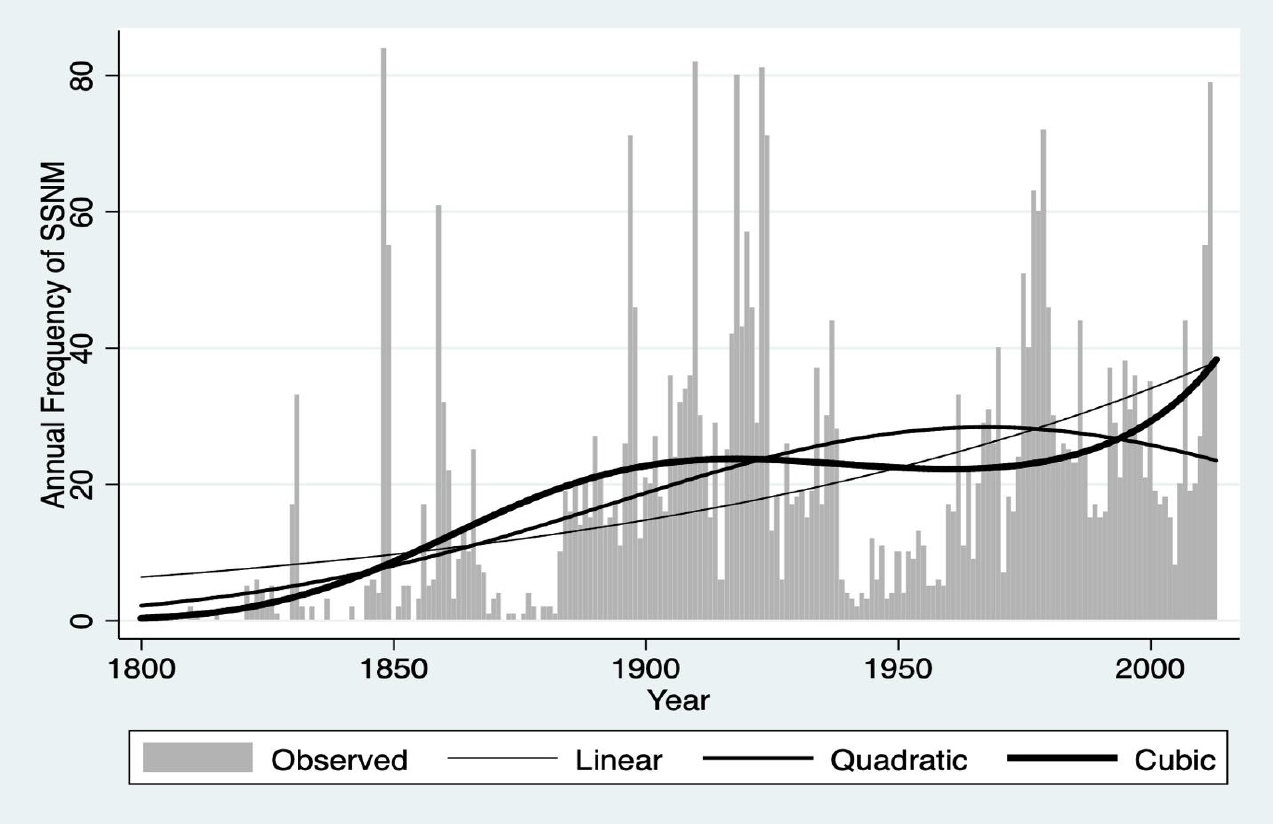
I begin discussion of the findings with the temporal and geographical domain from which most classical and contemporary accounts derive their generalizations about the trajectory of stateseeking nationalist mobilization: the Global North from 1800 to 20133.
Table 1 presents the Poisson models, and
Figure 1 visualizes the fitted trajectories.
The linear specification in the first model indicates a positive and statistically significant trend, suggesting a secular increase in nationalist mobilization after Industrial Revolution, French Revolution and the spread of many elements of modernity, as implied by perspectives highlighted by
Kedourie (1994),
Deutsch (1953) and
Gellner (1983) with respect to nationalism’s emergence and spread in relation to nationalist ideologies, social communication mechanisms and industrialization, respectively. However, this model provides only a partial account. Once a quadratic term is introduced, the pattern shifts: the positive coefficient on year combined with a negative coefficient on year² indicates an arc-shaped trajectory, with mobilization rising through the nineteenth century, reaching a peak, and subsequently declining right after the Second World War as argued by many historians and political scientists such as
Carr (1945),
Shafer (1955) and
Kohn (1956), to cite just a few. This specification is a stronger explanation of the temporal structure of nationalism as it substantially improves model fit (McFadden adj-R² increasing from 0.193 to 0.247). Yet, the cubic model further refines this temporal structure. The positive coefficient on year
3, alongside the negative quadratic term, indicates that the decline is not monotonic. Instead, nationalist mobilization follows a cyclical or wave-like pattern, characterized by periods of expansion that peaks in the early 20st century, contraction during the mid-20th century, and renewed resurgence that starts in the 20th and the early 21st century, which overlap with world hegemonic transitions as explained by
Karataşlı (2018,
2020) with respect to dynamics of state-seeking nationalism in the Global North. The improvement in model fit (McFadden adj-R² increasing from 0.247 to 0.288) suggests that this more complex specification captures important dynamics that simpler models obscure. Taken together, these results collectively challenge the null hypothesis—i.e., completely contingent nature of nationalist mobilization in the longue durée—while also complicating linear/serial, arcshaped/bounded and cyclical interpretations as there is a partial truth in all of them.
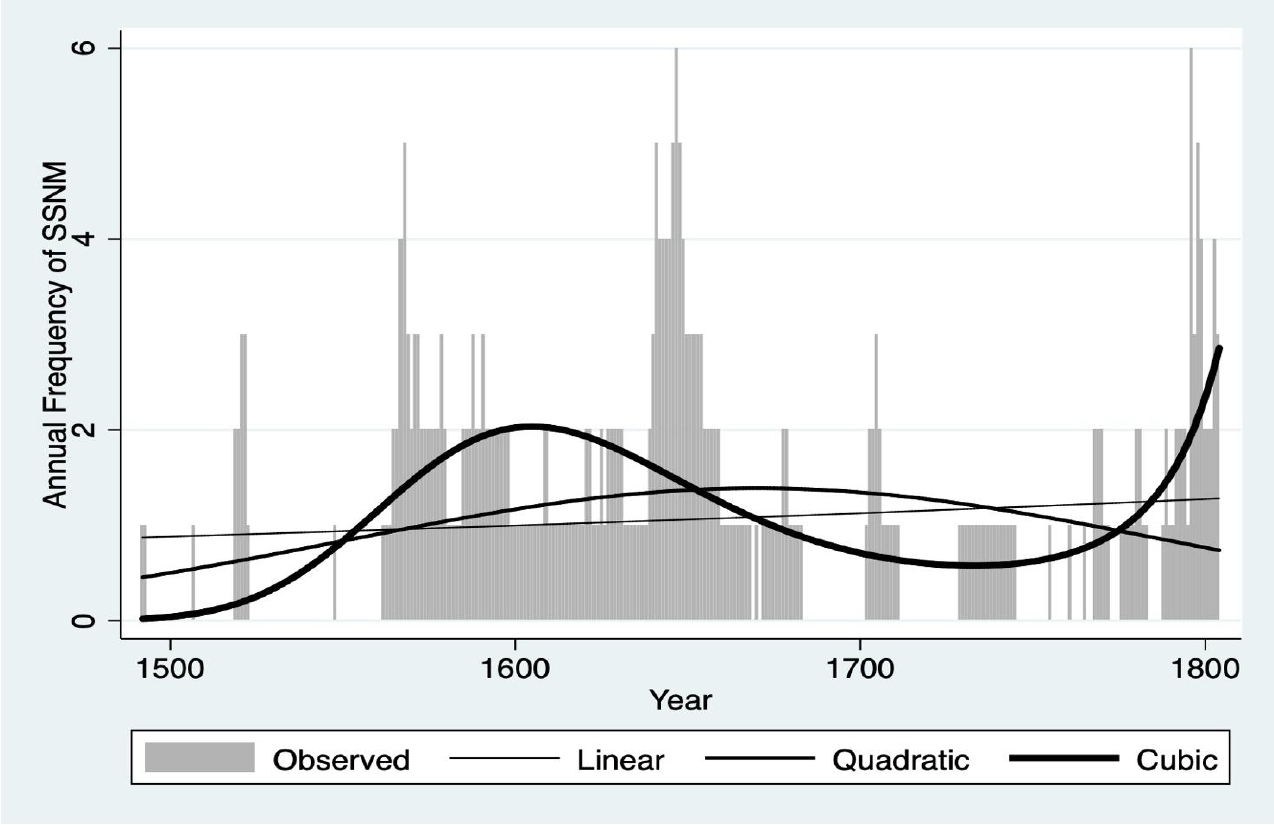
Table 2 and
Figure 2 develop the analysis by extending the temporal and geographical scope of the analysis to the entire capitalist world-system from 1492 to 2013. The results reveal distinct temporal structures of state-seeking nationalist movements across the two historical periods.
For the 1492–1804 period, the linear model suggests only a weak upward trend, making visible the dimension emphasized by diffusionist theories of nationalism that start nationalism’s origins with respect to developments in the sixteenth century and theorize their spread from then on (
Greenfeld, 1992). However, both higher-order specifications substantially improve model fit, with the cubic model providing the strongest explanatory power. The negative and significant quadratic term, combined with a positive cubic term, indicates a nonlinear, wave-like trajectory rather than a simple bounded arc. Substantively, this pattern reflects an early rise, followed by a decline, and then a renewed increase toward the late eighteenth century. The estimated turning points reinforce this interpretation: a local peak around the early seventeenth century (c. 1605), a trough in the early eighteenth century (c. 1730s), and renewed growth thereafter, which corresponds with world-hegemonic transitions from Dutch world hegemony to British world-hegemony (
Karataşlı, 2018,
2020) The relatively large improvement in McFadden’s adjusted R
2(from near zero in the linear model to 0.135 in the cubic model) further supports the presence of a cyclical temporal structure in this earlier period. Interestingly, these findings resemble very much to the results we have seen in the Global North in the post-19
th century era. Although the analysis presented for 1492-1804 period encompasses the entire capitalist world-system, it must be kept in mind that in this early period, much of the capitalist world-system was centered on Europe and the Western colonial offshoots in the Americas, as much of Asia and Africa has still not been included in the capitalist world-economy until the 19
th century.
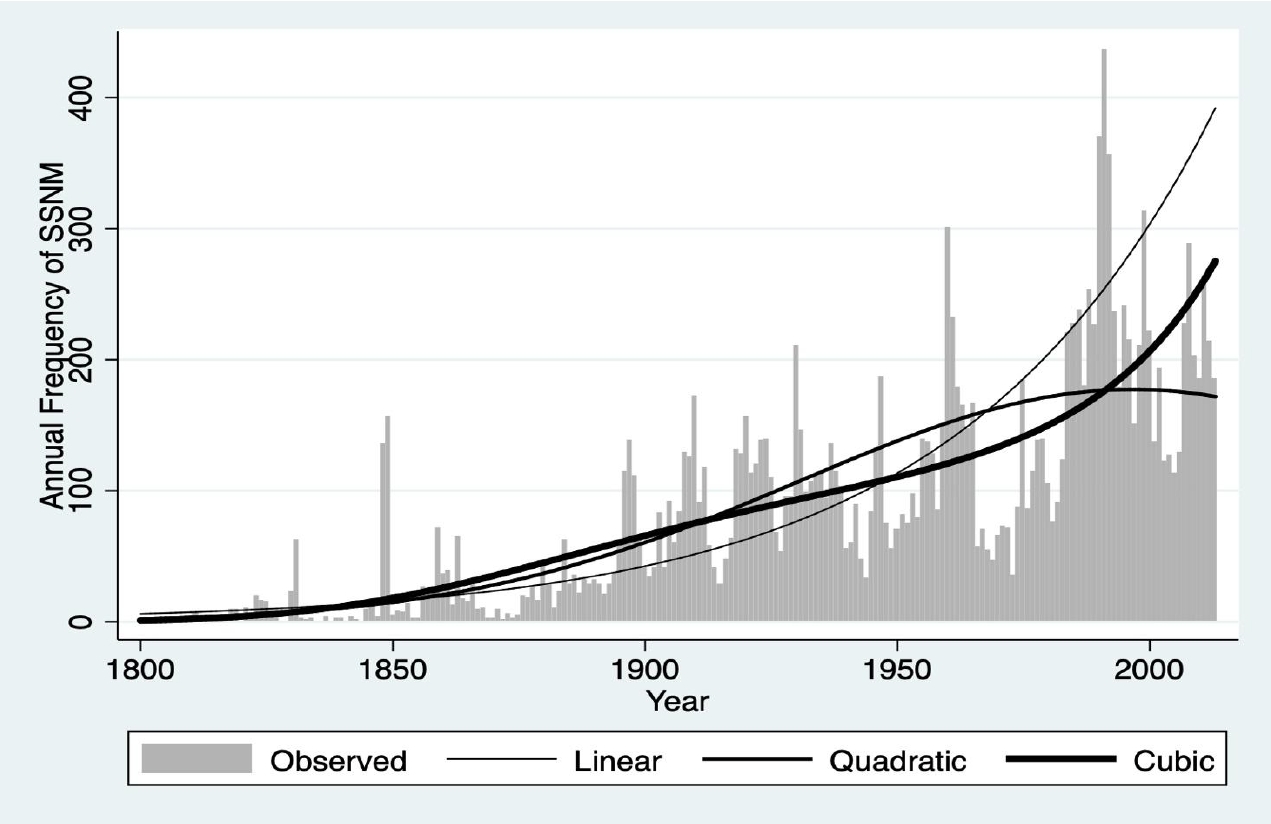
In contrast, the 1800–2013 period, which also includes the entirety of the Global South including Asia and Africa, period exhibits a markedly different pattern (see
Figure 3)
4. While the quadratic and cubic terms are statistically significant, all models indicate a strong and sustained upward trend in the frequency of state-seeking nationalist movements, as implied not only by
Kedourie (1994),
Deutsch (1953),
Gellner (1983) but also by world-polity scholars (
Meyer et al., 1997), perspectives that see nationalism as a reaction to globalization (
Castells, 2000) as well as
Lenin’s (1917/1999) theory that sees national liberation as a reaction to imperialism. Interestingly, although there is significant evidence for the arc-shaped temporal structure as well, in contrast to the dynamic we had observed in
Figure 1, the arc-shaped curve begins to decline not in the aftermath of World War II, but in the mid-1990s. This is the empirical base of the pattern that informs arguments which argues that nationalism begins to decline in the era of globalization (
Ohmae, 1996), due to triumph of liberal democracies after the collapse of USSR (
Fukuyama, 1992), or the very success of national liberation movements in the post-WWII era (
Arrighi et al., 2012). This suggests that the perceptions about when nationalism would begin to decline depends heavily on geographical scope of analysis.
Yet, as we can see from
Table 2, the cubic specification still improves model fit over the quadratic model. Due to inclusion of the Global South, whose temporal dynamics are not identical to the global North but in many ways the opposite of it (see
Karataşlı, 2020), however, instead of a clear cyclical fluctuation in the form of a rise-fall-rise movement that we saw in other periods, we see a pattern of acceleration, flattening/deceleration, and a pronounced re-acceleration that still correspond to world hegemonic transitions. The significance of all models yet the gradual increase in McFadden’s adjusted
R2(up to 0.0934) indicates that all temporal structures bear a certain truth in it, yet the cyclical specification captures dimensions of the historical trajectory that the linear and quadratic specifications leave unexplained.
Conclusion
This article has argued that debates over the long-term trajectory of nationalist mobilization in the world-system, at their core, include implicit discussions about the temporal structure of these movements. By introducing polynomial regression as a simple and flexible tool, it has shown how linear, quadratic, and cubic specifications of time correspond to distinct interpretations—secular (serial), arc-shaped (bounded), and cyclical—and how these alternatives can be evaluated using the same empirical series. The illustration with the SSNM data demonstrates that higher-order models can reveal recurrent patterns that simpler models obscure.
The findings also have implications for theories of nationalism, especially for debates about its supposed decline in the late twentieth and early twenty-first centuries. The results suggest that claims and predictions about nationalism’s decline are not simply wrong, but are strongly dependent on geographical and temporal scope of analysis. When viewed from the Global North after 1800, nationalist mobilization does show patterns of postwar decline or deceleration. Yet this interpretation changes once the analysis is extended to the entire capitalist world-system: the incorporation of the Global South shifts the timing and form of decline and reveals a longer trajectory of expansion, deceleration, and renewed mobilization. In this sense, the findings correct theories of nationalism’s decline by showing that what appears as exhaustion or obsolescence from one geographical and temporal standpoint may appear, from a world-systemic perspective, as one phase within a broader and uneven historical trajectory. Likewise, when we expand the temporal frame of analysis, it becomes clearer why the recent resurgence of nationalist movements are not an anomaly, but part of the cyclical temporal structure.
There is also a broader theoretical implication: the major traditions examined in this article should not be understood simply as mutually exclusive explanations, with one perspective replacing the others. Modernization, diffusionist, and world-polity approaches are correct to emphasize the longterm expansion of nationalist mobilization, especially after the nineteenth century. Postwar and postnational perspectives capture real periods of decline or deceleration, but they misrecognize these as evidence of nationalism’s general historical exhaustion when the analysis remains too narrowly centered on the Global North. Cyclical and world-systemic approaches, in turn, capture recurrent waves of expansion, contraction, and renewed mobilization—including the revival of nationalism in the early twenty-first century—that become visible when the analysis is extended across longer historical periods and wider geographical scopes. The central theoretical implication is therefore that nationalism in the world-system is not governed by a singular temporal structure, but is better understood as the outcome of overlapping temporalities that include secular expansion, bounded arcs, recurrent waves, and eventful conjunctures.
The contribution is therefore both methodological and theoretical/epistemological. Rather than privileging any single theoretical account, the approach highlights how different modeling choices make different temporal structures visible. Polynomial regression does not provide a neutral standpoint from which theories of nationalism can be mechanically confirmed or rejected. Rather, it helps identify the temporal and spatial conditions under which particular interpretations become plausible. Linear, arc-shaped, and cyclical accounts may each capture real dimensions of the same historical process, depending on the period, geography, and scale of observation. Used in this way, polynomial regression becomes a post-positivist heuristic: a tool for clarifying historically situated patterns rather than proving universal laws.
Notes
Supplementary Information
Figure 1.Competing Predictions of Temporal Structures in the Global North, 1800–2013
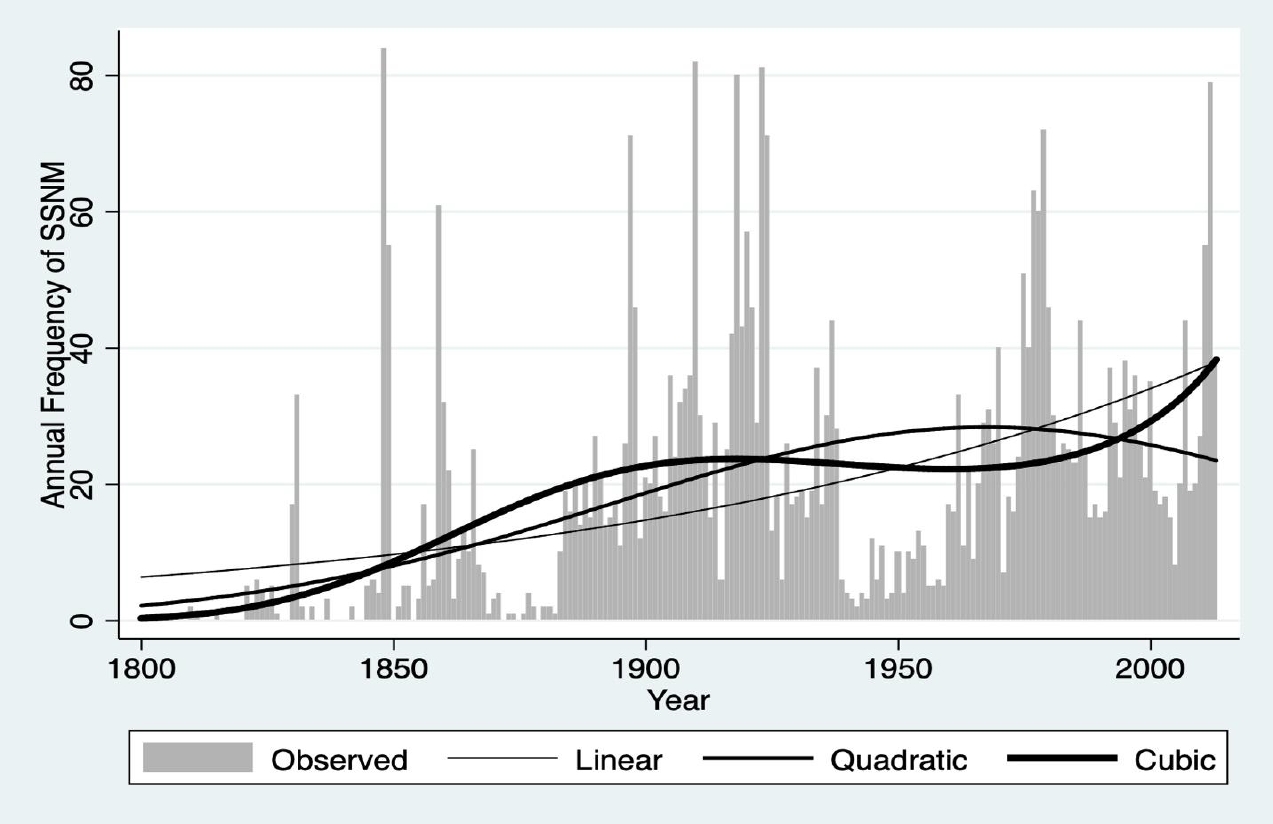
Figure 2.Competing Predictions of Temporal Structures in the World-System, 1492–1804
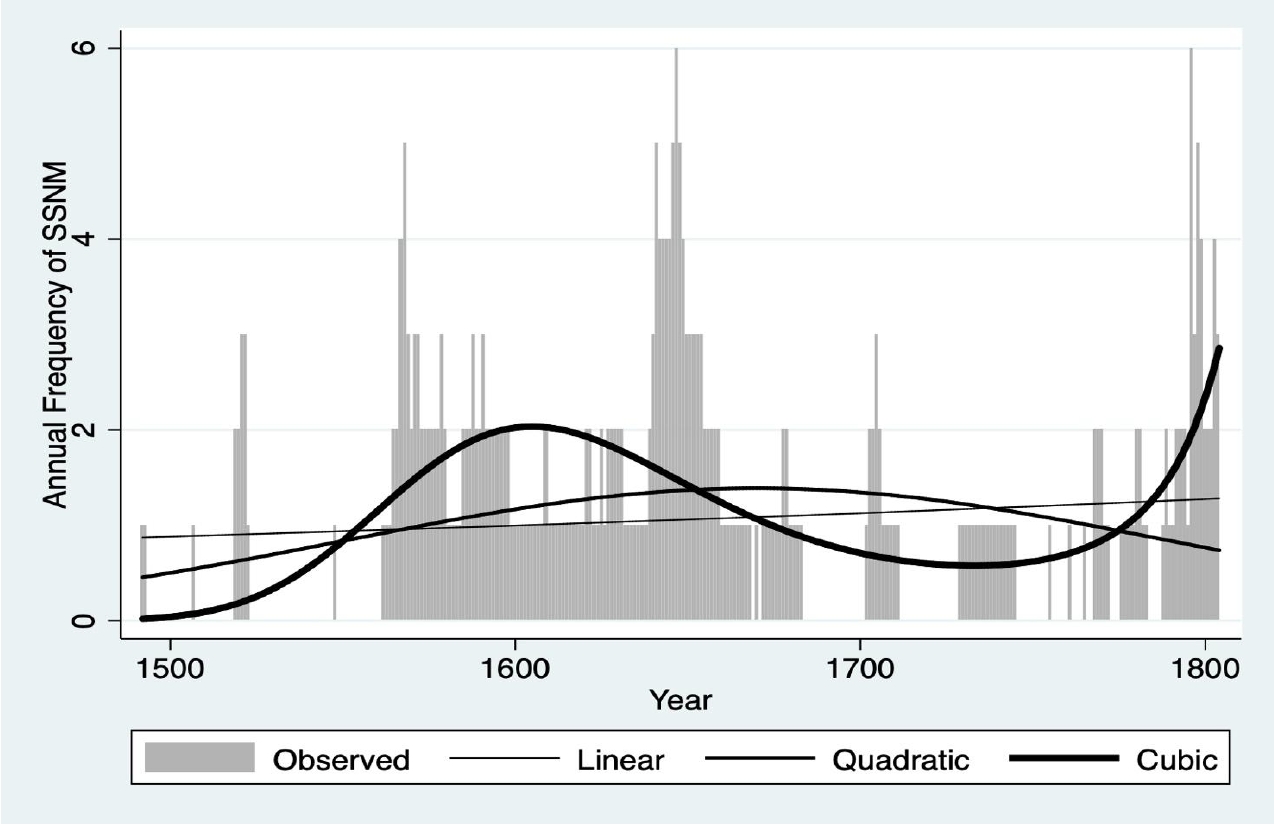
Figure 3.Competing Predictions of Temporal Structures in the World-System, 1800–2013
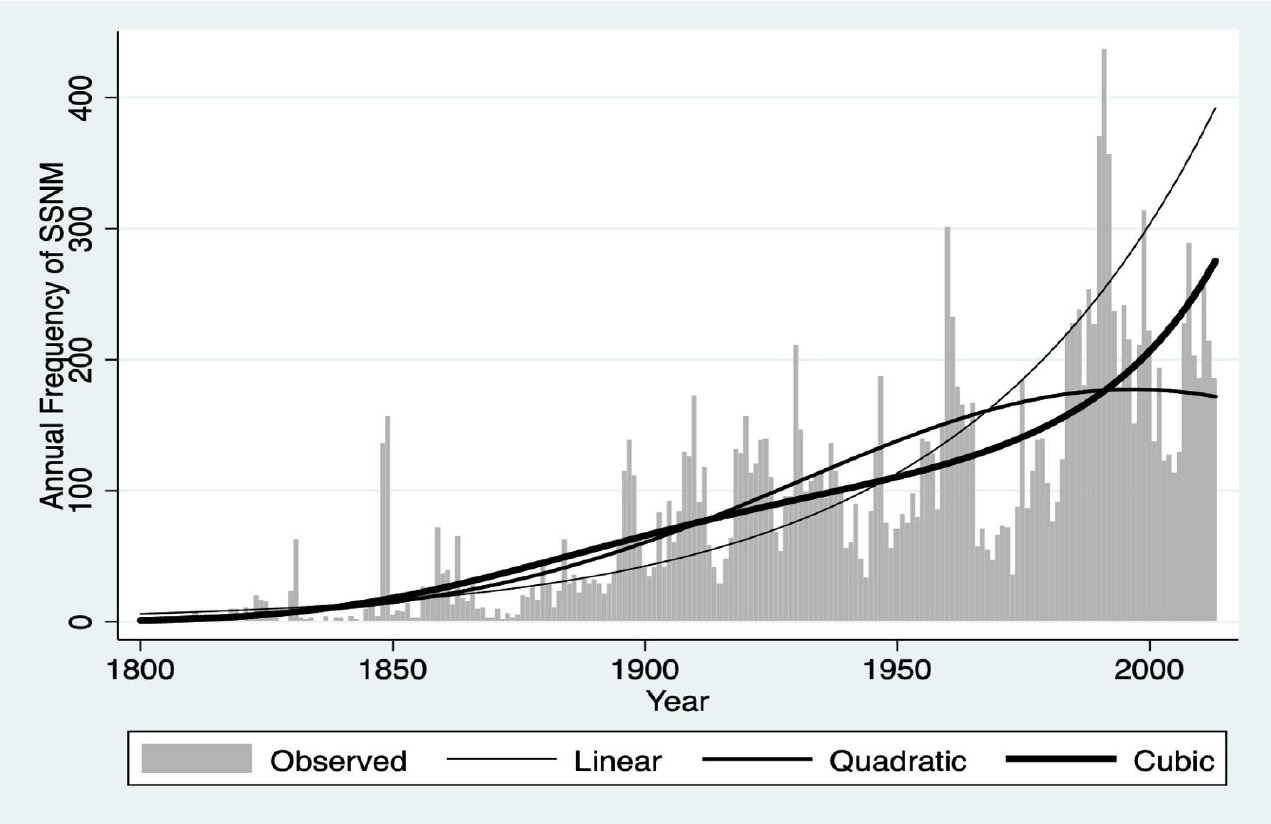
Table 1.Polynomial Regression Models of State-Seeking Nationalist Movements in the Global North, 1800–2013
Table 1.
|
1800-2013, Global North Only (Poisson Models)
|
|
Linear |
Arc-Shaped |
Cubic/Cyclical |
|
year |
0.00835***
|
0.0111***
|
0.00301***
|
|
(29.48) |
(28.81) |
(4.33) |
|
year² |
|
-0.0000911***
|
-0.000162***
|
|
(-15.43) |
(-17.72) |
|
year³ |
|
|
0.00000167***
|
|
|
(13.47) |
|
Constant |
2.748***
|
3.008***
|
3.151***
|
|
(149.73) |
(128.16) |
(126.21) |
|
N |
214 |
214 |
214 |
|
Log Likelihood |
-1955.0 |
-1821.9 |
-1720.8 |
|
McFadden adj-R² |
0.193 |
0.247 |
0.288 |
Table 2.Polynomial Regression Models of State-Seeking Nationalist Movements, 1492–1804 and 1800-2013, Entire Capitalist World-System
Table 2.
|
1492–1804, Entire Capitalist World-System (Poisson Models)
|
1800–2013, Entire Capitalist World System (Negative Binomial Models)
|
|
Linear |
Arc-Shaped |
Cubic/Cyclical |
Linear |
Arc-Shaped |
Cubic/Cyclical |
|
Year |
0.00122*
|
0.00155*
|
-0.0132***
|
0.0197***
|
0.0207***
|
0.0133***
|
|
(2.01) |
(2.25) |
(-7.82) |
(16.42) |
(21.02) |
(5.41) |
|
Year² |
|
-0.0000352***
|
-0.0000751***
|
|
-0.000115***
|
-0.000131***
|
|
(-4.22) |
(-6.38) |
|
(-6.31) |
(-6.94) |
|
Year³ |
|
|
0.00000120***
|
|
|
0.00000116**
|
|
|
(9.27) |
|
|
(3.24) |
|
Constant |
0.0558 |
0.311***
|
0.377***
|
3.875***
|
4.243***
|
4.277***
|
|
(1.01) |
(4.04) |
(4.76) |
(61.76) |
(47.94) |
(48.53) |
|
ln(α) |
No overdispersion |
-0.212*
|
-0.384***
|
-0.421***
|
|
(-2.00) |
(-3.52) |
(-3.87) |
|
N |
313 |
313 |
313 |
214 |
214 |
214 |
|
Log Likelihood |
-442.1 |
-432.5 |
-380.1 |
-1044.6 |
-1026.9 |
-1021.6 |
|
McFadden’s adj. R² |
0.0000723 |
0.0195 |
0.135 |
0.0748 |
0.0896 |
0.0934 |
REFERENCES
- Anderson, B. (1991). Imagined communities. Verso.
- Arrighi, G. (1994). The long twentieth century. Verso.
- Arrighi, G., Hopkins, T. K., & Wallerstein, I. (2012). Anti-systemic movements. Verso.
- Arrighi, G., Korzeniewicz, R. P., Consiglio, D., & Moran, T. P. (1996). Modeling zones of the worldeconomy: A polynomial regression analysis (1964-1994) [Paper presentation] Annual Meeting of the American Sociological Association. New York, NY, USA.
- Arrighi, G., & Silver, B. J. (1999). Chaos and governance in the modern world system. University of Minnesota Press.
- Beissinger, M. R. (2002). Nationalist mobilization and the collapse of the Soviet state. Cambridge University Press.
- Bergesen, A., & Schoenberg, R. (1980). Long waves of colonial expansion and contraction, 1415-1969. In A. Bergesen (Ed.), Studies of the modern world-system (pp. 231–278)). Academic Press.
- Braudel, F. (1972). The Mediterranean and the Mediterranean world in the age of Philip II (Vol. 1). Harper & Row.
- Carr, E. H. (1945). Nationalism and after. Macmillan.
- Castells, M. (2000). The end of millennium (2nd ed., Vol. 3). Blackwell.
- Deutsch, K. W. (1953). Nationalism and social communication. John Wiley & Sons.
- Frank, A. G., & Fuentes, M. (1994). On studying the cycles in social movements. Research in Social Movements, Conflicts and Change, 17, 173–196.
- Fukuyama, F. (1992). The end of history and the last man. Penguin.
- Gat, A., & Yakobson, A. (2013). Nations. Cambridge University Press.
- Gellner, E. (1983). Nations and nationalism. Basil Blackwell.
- Greenfeld, L. (1992). Nationalism: Five roads to modernity. Harvard University Press.
- Hobsbawm, E. (1992). Nations and nationalism since 1780: Program, myth, reality (2nd ed.). Cambridge University Press.
- Karataşlı, Ş. S. (2018). Political economy of secession. In A. J. Bergesen & C. Suter (Eds.), The return of geopolitics (pp. 69–95). Lit Verlag.
- Karataşlı, Ş. S. (2020). Capitalism and nationalism in the longue durée. International Journal of Comparative Sociology, 61(4), 233–263. https://doi.org/10.1177/0020715220946473
- Karataşlı, Ş. S. (2023). The use of digitized newspaper archives for world-historical research on social conflicts. In T. V. Maher & E. W. Schoon (Eds.), Methodological advances in research on social movements, conflict, and change 47:(pp. 37–68). Emerald Publishing. https://doi.org/10.1108/S0163-786X20230000047003
- Kedourie, E. (1994). Nationalism. Blackwell.
- Kohn, H. (1956). The idea of nationalism. Macmillan.
- Kreuzer, M. (2023). The grammar of time: A toolbox for comparative-historical analysis. Cambridge University Press.
- Lenin, V. I. (1999). Imperialism: The highest stage of capitalism. Resistance Books. (Original work published 1917).
- Long, J. S. (1997). Regression models for categorical and limited dependent variables. Sage.
- McNeill, W. H. (1986). Polyethnicity and national unity in world history. University of Toronto Press.
- Meyer, J. W., Boli, J., Thomas, G. M., & Ramirez, F. O. (1997). World society and the nation-state. American Journal of Sociology, 103(1), 144–181.
- Nairn, T. (1977). The break-up of Britain. NLB.
- Ohmae, K. (1996). The end of the nation state: The rise of regional economies. Harper Collins.
- Sewell, W. H. (2008). The temporalities of capitalism. Socio-Economic Review, 6(3), 517–537. https://doi.org/10.1093/ser/mwn007
- Shafer, B. C. (1955). Nationalism. Harcourt, Brace and Company.
- Tilly, C. (1994). States and nationalism in Europe 1492-1992. Theory and Society, 23(1), 131–146.
- Wallerstein, I., & Phillips, P. D. (1991). National and world identities and the interstate system. In I. Wallerstein (Ed.), Geopolitics and geoculture: Essays on the changing world-system (pp. 139–157). Cambridge University Press.
- Wimmer, A. (2013). Waves of war. Cambridge University Press.