Abstract
Social class and cohort are widely recognized as two key factors that shape parenting attitudes. Yet studies rarely examine them together or assess their relative importance. This study investigates how these two factors jointly influence parenting attitudes. Using data from the 2021 Taiwan Social Change Survey (Family Module), the study examines four measures of parenting attitudes related to parent–child interactions: joint decision-making, preference fulfillment, rule enforcement, and nonintervention. The results show that class is positively associated with joint decision-making and negatively associated with nonintervention, whereas cohort is not significantly associated with any of the four measures. Furthermore, class-based differences are consistently negligible across cohorts. By highlighting the central role of social class, this study shows that parenting attitudes constitute an important domain through which social inequality is reproduced.
-
Keywords: Parenting Attitudes; Class; Cohort; Taiwan
Introduction
How do social class and cohort shape parenting attitudes? Research identifies parenting attitudes as a key mechanism in the reproduction of inequality, as they shape the values and orientations that guide childrearing practices and, ultimately, children’s outcomes. Yet, how these factors jointly influence parenting attitudes remains unclear. The stratification perspective emphasizes social class as the primary factor by arguing that occupational conditions influence value orientations and the characteristics parents emphasize in raising their children (
Kohn, 1969,
1976). By contrast, the cultural change perspective attributes differences in parenting attitudes to shifts in parenting norms across cohorts (
Hays, 1996;
Zelizer, 1994). While both class and cohort are important determinants of parenting attitudes, research has largely examined them independently. Consequently, relatively less is known about how they interact to shape parenting attitudes.
Studies adopting the stratification perspective show that class significantly affects parenting attitudes, and that class-based differences in these attitudes contribute to children’s educational trajectories, accumulation of cultural capital, and long-term outcomes (
Lareau, 1987,
2003). Literature emphasizing the importance of cultural change finds cohort-based transformations in parenting norms, such as a long-term decline in authoritarian parenting and a corresponding rise in the emphasis on parent-child communication, emotional responsiveness, and child-centeredness across cohorts (
Martin et al., 1991;
Trifan et al., 2014). East Asian societies have also experienced a shift away from exam-centered approaches toward more communicative and psychologically attentive parenting attitudes (
Fung et al., 2017;
Lan, 2014,
2019;
Lee & Han, 2021).
An alternative perspective contends that cohort is the primary force shaping parenting attitudes. Emphasizing the importance of cohort, some scholars argue that processes of social change can generate new parenting norms, resulting in distinctive cohort-based attitudes that are shared across different class backgrounds (
Hays, 1996;
Trifan et al., 2014;
Zelizer, 1994). At the same time, class and cohort may interact to shape parenting attitudes. For example, cohort change may attenuate, reinforce, or transform class-based inequalities in parenting. If class differences remain the most significant source of variation, this would suggest that socioeconomic inequalities in parenting are reproduced over time. Yet, if cohort differences diminish class disparities, or if the relationship between social class and parenting attitudes varies across cohorts, this would indicate that generational change plays a particularly important role. Understanding whether and how social class and cohort jointly shape parenting attitudes is therefore necessary to assess the extent to which parenting attitudes reflect enduring class-based inequalities or broader processes of social change.
This study examines whether and how parenting attitudes vary by social class and birth cohort. We use data from the 2021 Taiwan Social Change Survey (Family Module), a nationally representative survey of adults in Taiwan. The data include parents born from 1926 to 1999, all of whom answered a set of attitude questions related to parent-child interaction. We examine the case of Taiwan because, similar to other East Asian societies, it has undergone rapid social transformation. This context offers a valuable setting for assessing whether parenting attitudes are more strongly shaped by enduring class-based differences or by cohort-based change. Following existing literature, parenting attitudes are defined as parents’ evaluative beliefs, normative orientations, and judgments about appropriate childrearing (
Holden & Edwards, 1989). These attitudes reflect how parents interpret their roles, justify childrearing decisions, and evaluate parent-child interactions.
Scholars emphasize the significance of parenting attitudes in influencing children’s outcomes and hence social inequality (
Kohn, 1976;
Lareau, 2003). Building on this tradition, this study examines the temporal and socioeconomic dimensions that collectively contribute to the attitudes parents hold in childrearing. Although the findings are based on Taiwan, the society’s shared developmental trajectories and rapid social change with other East Asian countries carries implications beyond the Taiwanese context. The findings contribute to furthering understanding of how social inequality is reproduced within the family.
Parenting Attitudes: Class and Cohort
Parenting is a key mechanism in the intergenerational reproduction of social inequality (
Lareau, 2003;
McLanahan & Percheski, 2008). Studies show that social class shapes parenting attitudes, approaches, practices, and goals (
Conger & Donnellan, 2007). While much prior research has focused on parenting practices, relatively less attention has been paid to parenting attitudes, which are evaluative beliefs and normative orientations toward childrearing. However, despite the relatively less attention, parenting attitudes are key to understanding inequality because they guide decision-making and shape the priorities parents emphasize in raising children, thereby influencing the development of children’s skills, behaviors, and ultimately their life chances (
Holden & Edwards, 1989).
Among the many factors that shape parenting attitudes (
Bornstein et al., 2011), socioeconomic status, or class background, is often recognized as a key determinant (
Ishizuka, 2025;
Lee, 2023). Parents’ occupational conditions influence their value orientations and access to resources, which in turn shape the traits they seek to cultivate in their children (
Kohn, 1976;
Vincent, 2001).
Kohn (1969,
1976) finds that parents in autonomous occupational positions emphasize children’s self-direction and independence, whereas those in constrained work environments likely prioritize conformity and obedience. Subsequent research extends this perspective by demonstrating that social class structures parents’ beliefs about appropriate childrearing and their level of involvement in children’s development (
Vincent, 2001). In the East Asian context, these class-based differences are comparable to those observed in the West: affluent families adopt intensive, education-oriented parenting, while working-class families emphasize compliance and constraint (
Kobakhidze et al., 2024;
Lee, 2023).
Another line of research highlights the role of cohort effects in shaping parenting attitudes (
Ishizuka, 2019;
Trifan et al., 2014). This perspective emphasizes changes in the meanings of childhood and the norms of appropriate parenting over time (
Hays, 1996;
Zelizer, 1994). In this perspective, cohorts are exposed to changes in the socioeconomic and cultural contexts, including educational expansion, economic development, declining birth rates, and shifting conceptions of childhood, all of which facilitate cohort-based parenting attitudes (
Hays, 1996). These newly developed norms and ideals of parenting could strongly influence parents’ attitudes regardless of their socioeconomic and occupational positions, thereby showing cohort-based changes in parenting attitudes. For example, contemporary parenting norms emphasize communication, emotional responsiveness, and child-centered interaction (
Faircloth, 2023), whereas earlier cohorts highlight conformity, obedience, and structured authority. These findings suggest that parenting attitudes reflect the dominant norms of each cohort, potentially diminishing the role of class-based differences.
In addition to examining whether class or cohort exerts stronger influence on parenting attitudes, it is also possible that the importance of socioeconomic background varies across cohorts (
Prickett & Augustine, 2021). In some cohorts, parents may be more likely to conform to prevailing parenting norms, resulting in relatively uniform attitudes across social classes, whereas in others, class-based differences may remain more pronounced. Although direct evidence on parenting attitudes is limited, studies of parenting practices suggest a similar tension: while parenting norms may be widely shared, their enactment remains stratified by socioeconomic constraints (Randles, 2021). These findings do not directly address attitude differences, but they nonetheless indicate that shared norms may coexist with persistent inequality, leaving open the possibility that the influence of socioeconomic background varies across cohorts.
Taken together, class, cohort, and their potential interaction contribute to shaping parenting attitudes, but these relationships have yet to be fully examined. This study examines how class and cohort shape parenting attitudes. We investigate whether class-based differences in parenting attitudes persist or are reshaped across cohorts, and whether the importance of social class varies depending on cohort. Building on existing literature documenting class- and cohort-based differences in parenting attitudes, we examine these relationships through three questions: First, do parenting attitudes differ by class? Second, do parenting attitudes differ across cohorts? And third, do the associations between class and parenting attitudes vary across cohorts?
The Taiwanese Context
We draw on data from Taiwan, where family norms have shifted substantially over the past few decades alongside rapid socioeconomic development (
Thornton & Lin, 1994;
Yi, 2019). These shifts in family organization and social context have resulted in changes in parenting discourses and childrearing ideologies (
Lan, 2014), which are likely linked to class-based and cohort differences in childrearing orientations (
Hays 1996). The case of Taiwan therefore provides a useful setting for assessing the relative importance of social class and cohort in shaping parenting attitudes.
Research shows that there are substantial class-based differences in parenting approaches in Taiwan (
Lan, 2019;
Shih & Yi, 2014). Taiwanese middle-class parents, like their counterparts in the West (
Lareau 2003), are more actively involved in their children’s education and more likely to encourage children’s participation in extracurricular activities than working-class parents (
Lan, 2019;
Shih & Yi, 2014). These class-based differences are also evident in the ways through which parents support their children under intense educational competition. For example,
Wu (2016) finds that middle-class parents are more likely to emphasize effort and strategic planning, whereas working-class parents tend to attribute outcomes to external circumstances, reflecting a more fatalistic orientation toward education.
Scholars find that cohort differences also influence parenting approaches in Taiwanese society (
Shih, 2019;
Wu & Gao, 1997). For example, agreement with harsh parenting practices has declined substantially among younger cohorts and among parents with higher educational attainment (
Wu & Gao, 1997). Consistent with this trend, although practices such as corporal punishment are still regarded by some parents as a means of discipline, traditional hierarchical norms have weakened, and contemporary parenting places greater emphasis on more egalitarian parent-child relationships (
Lin & Wang, 1995). These studies suggest that parenting approaches in Taiwan have changed over time, but they leave open the question of whether cohort differences remain important once social class is taken into account.
There is also evidence that parenting approaches in Taiwan are jointly influenced by social class and cohort. Parenting discourses have undergone rapid transformation under the influence of global ideas and local traditions, so that emerging childrearing ideologies are not adopted uniformly across social groups.
Lan (2014) shows that parenting attitudes vary across social class and cohorts, reflecting differences in resources, experiences, and exposure to global parenting norms. Yet, although these findings suggest that parenting attitudes in Taiwan vary along both class and cohort lines, most studies have focused on children's educational outcomes rather than examining how social class and cohort jointly influence parenting attitudes. As a result, the relative importance of class and cohort, as well as the ways in which they may intertwine or interact in shaping parenting attitudes, remains unclear.
Data and Methods
This study uses data from the Family Module of the 2021 Taiwan Social Change Survey (TSCS), a nationally representative, cross-sectional survey of 1,573 Taiwanese adults between 20–95 years-old, or born between 1926 and 1999. The module includes questions on respondents’ parenting attitudes and family characteristics, allowing for comparisons across cohorts and social class. For the purpose of this study, we dropped the respondents who were not married or without children (N = 587), we also excluded respondents with incomplete answers for the dependent variables (N = 8). The final sample consists of 978 respondents.
The dependent variables are four parenting attitude items about parent-child interactions. Respondents reported the extent to which they agreed with four questions on interactions with their child aged 18 or younger, or, if all children were adults at the time of the survey, with their youngest child when he or she was under 18. These four items are: (1) I try to satisfy my child’s preferences whenever possible; (2) I require my child to follow my rules or arrangements; (3) when my child and I disagree, we discuss and decide together; and (4) I rarely interfere with my child’s activities. For ease of presentation, we refer to these items respectively as preference fulfillment, rule enforcement, joint discussion, and nonintervention. Responses were recorded on a five-point Likert scale and reverse-coded so that higher values indicate greater endorsement of each item. Since the items were not designed to and do not form a coherent scale, we analyze the items separately rather than as indicators of a unified parenting-attitude construct.
It should be noted that, although these items intend to capture parenting experiences and approaches, some responses are reported retrospectively. Older respondents, in particular, rely on recollections of interactions that may have occurred decades earlier. Given the substantial time lag and the potential for recall bias (
Tourangeau et al., 2000), these responses are best interpreted as generalized assessments of past parent-child interactions. We interpret these measures as reported attitude items rather than direct measures of parenting experiences, and conduct robustness checks with respondents who did not report retrospectively.
Our key independent variables are social class and cohort. Following existing research, we treat socioeconomic status as a multidimensional construct (
Hodge & Treiman, 1968). We construct a latent scale of social class based on respondents’ income, occupation, and educational attainment (
Bollen et al., 2007;
Duncan et al., 2002). This approach is also suitable in the Taiwanese context, where rapid educational expansion has complicated the use of educational attainment as a standalone indicator of class position (
Chen & Chen, 2021). The resulting measure is a standardized measure of SES, with higher values indicating higher social class position.
We distinguish three birth cohorts that reflect changes in social developments, with boundaries reflecting major societal shifts such as fertility decline, educational expansion, and industrial development. The older cohort includes individuals born between 1926 and 1964, who came of age during the World War and regime change, early onset of industrialization, and had high fertility rates. The middle cohort are respondents born between 1965 and 1979, who grew up during a period of rapid economic growth, rapid educational expansion, and the fertility decline. The younger cohort comprises respondents born between 1980 and 1999, who experienced the massification of higher education and sustained low fertility in post-industrial Taiwan.
We also control for several demographic characteristics associated with parenting attitudes (
Holden & Edwards, 1989). These include gender, parents’ highest level of education (1 = junior high or below, 2 = senior high school, 3 = college and above), ethnicity (0 = Minnan, 1 = all others), residential area (1 = metropolitan, 2 = city, 3 = township, 4 = rural), and number of children. Finally, to account for retrospective reporting, we include an indicator of whether the respondent’s youngest child is currently under age 18.
Table 1 presents the descriptive statistics for all variables.
We use multiple imputation to retain the sample size. The imputation model included all variables used in the analysis. Respondents who were missing on the dependent variables were included in the imputation but later dropped in the analysis. There was no missing for gender, birth year, and residential area. The proportion of imputed responses ranged from 1.64% for whether the youngest child was younger than 18 to 7.06% for respondents’ income.
The analysis uses a series of ordered logistic models to examine how the four attitude items vary by social class and birth cohort. The items are analyzed separately. Model 1 includes social class, controlling for demographic and family characteristics. Model 2 includes cohort, with the same controls. Model 3 includes both social class and cohort, along with all control variables. Model 4 further includes an interaction between social class and cohort.
To assess whether retrospective reporting affect the findings, we conducted robustness checks for all four items. We first restricted the sample to respondents in the middle and younger cohorts whose youngest child was under age 18 at the time of the survey (N = 355). We then ran the same models for all parents in those two cohorts (N = 465), with an additional control variable of whether the respondent’s child was under the age 18 at the time of survey. Comparisons between the two sets of analyses are reported briefly, and the findings of the robustness checks are available upon request.
Findings
We first present the distributions of each of the four parenting attitudes by social class and cohort. Panel a in
Figure 1 displays the distributions by social class, grouped into quartiles. Overall, respondents across all class groups show high levels of support for joint discussion with children, consistent with the mean reported in
Table 1 (M = 3.91 out of 4). The lowest class quartile shows slightly lower levels of agreement (M = 3.76), and the difference is significantly different from other quartiles based on t-tests. Responses related to fulfilling children’s preferences do not follow a clear gradient by class. The lowest quartile reports the highest level of agreement, followed by the highest quartile, with lower levels observed in the middle quartiles. By comparison, non-intervention attitudes exhibit a clear negative gradient by class. Non-intervention attitudes are most common among respondents in the lowest quartile and least common among those in the highest quartile. By contrast, rule enforcement follows a positive class gradient, as it is more prevalent among higher class quartiles and least prevalent in the lowest quartile.
Panel b presents cohort differences in parenting attitudes. Respondents across cohorts generally express high levels of agreement with joint discussion and decision-making, although the oldest cohort reports a slightly lower mean (M = 3.82), and these differences are statistically significant based on t-tests. Parents in the older cohort (M = 3.01) and younger cohort (M = 2.95) more frequently report trying to satisfy children’s preferences than those in the middle cohort (M = 2.75). Non-intervention attitudes are most common among the oldest cohort, followed by the middle and then the youngest cohort. By comparison, rule enforcement is most prevalent among the youngest cohort, followed by the middle and then the oldest cohort.
These descriptive findings indicate that parenting attitudes vary by both class and cohort. However, while certain attitudes exhibit clear gradients by class and cohort, such as non-intervention and rule enforcement, others do not. Certain groups are distinct in their responses: the oldest cohort and the lowest class quartile are least likely to engage in joint discussion with children, while the middle cohort and middle-class quartiles are less likely to report satisfying children’s preferences. These patterns suggest that socioeconomic position and cohort-based social change may simultaneously influence parenting attitudes. We proceed with multivariate regression analyses to assess the independent and joint effects of social class and cohort for each attitude.
Table 2 presents the results for the item measuring joint discussions with children and preference fulfillment. Examining the result for joint discussion, Model 1 shows that class is positively associated with having joint discussions. Some control variables are significant as well, such as mothers and those who are not reporting retrospectively are likely to agree with this statement. Model 2 shows that cohort is not significantly related to this attitude item, indicating that the results in the figures are partially explained by including control variables. Also in Model 2, mothers have stronger levels of agreement than fathers. When examining both class and cohort, Model 3 shows that class remains significantly and positively related to having joint discussions, while cohort does not. Model 4 further shows that there is no significant interaction between class and cohort. This indicates that the association between class and joint discussion does not significantly vary across cohorts.
Turning attention to the results for preference fulfillment, Model 1 shows that class is not significantly associated with the degree to which parents report support fulfilling children’s preferences whenever possible. Among the control variables, mothers are less likely than fathers, and non-Minnan are less likely than Minnan to agree with this statement. Model 2 indicates that the middle cohort is significantly less likely to report preference fulfillment compared to the oldest cohort, while there is no significant difference between the youngest and oldest cohorts. However, examining both class and cohort, Model 3 shows that neither class nor cohort is significant. Model 4 further shows that the interaction between the two is not significant. Among the control variables, gender and ethnicity remain statistically significant across models.
Examining the outcome for nonintervention, Model 1 shows that class is significantly and negatively associated with nonintervention, net of demographic controls. Female respondents and those reporting on current (rather than retrospective) parenting are less likely to endorse nonintervention than male respondents and those reporting retrospectively. Model 2 shows that cohort is not significantly associated with non-intervention, although the coefficient for the younger cohort is negative relative to the oldest cohort. In Model 3, which includes both class and cohort, the negative association between class and non-intervention remains statistically significant, while cohort remains non-significant. Model 4 shows that the interaction between class and cohort is not statistically significant, indicating that the association between class and non-intervention does not vary across cohorts.
Finally, focusing on the results for rule enforcement, Model 1 shows that class is not significantly associated with rule enforcement. Among the control variables, the number of children and reporting on current (rather than retrospective) parenting are positively related to rule enforcement. Cohort is not significantly related to rule enforcement in Model 2. In Model 3, neither class nor cohort is statistically significant, and Model 4 shows no significant interaction between the two. The positive associations for number of children and non-retrospective reporting remain consistent across models.
Considering that a sizable portion of the results are retrospective reports, we also check for robustness by comparing the young and middle cohorts with and without retrospective reports. The findings are largely comparable. Class is not significantly related to rule enforcement and preference fulfillment and is negatively related to nonintervention in both samples. With regard to joint discussion, class is only marginally significant in Model 4 of the non-retrospective sample, but is significant in the larger sample. However, this is likely due to changes in sample size, and the estimates are otherwise similar in magnitude and direction. Cohort shows no significant association with any of the four parenting attitude items, and the interaction between class and cohort is not statistically significant. Overall, the results are broadly consistent with and without retrospective reports, suggesting limited sensitivity to their inclusion
Discussion
This study examined whether class, cohort, or the interaction between the two shapes parenting attitudes. Using the example of parents in Taiwan, the results show that class is significantly associated with two of the four attitude items: it is positively related to joint discussion and negatively related to nonintervention. By comparison, cohort is not significantly related to the four attitude items once class and other controls are included, and the interaction between class and cohort is not statistically significant across the four items. Taken together, these findings suggest that class is more consistently associated with selected parenting attitude items than cohort, and that class-based differences are item-specific rather than uniform across all measures.
The limited cohort differences observed in this study are somewhat surprising, given that prior literature suggests that parenting attitudes may shift in response to broader sociocultural change. One possible explanation is that rapid socioeconomic development has not fully displaced enduring cultural orientations. This pattern is consistent with the truncated modernity and compressed modernity theories, both of which argue that rapid economic and institutional change coexists with persistent cultural traditions (
Coronil, 1997;
Chang, 2010). In this context, variation in parenting attitudes may remain more strongly structured by unequal access to socioeconomic resources than by cohort replacement. The absence of clear cohort differences should therefore be interpreted not as evidence that parenting attitudes are historically unchanged, but as suggesting that cohort-based change is less visible than class-based differences in the present analysis.
At the same time, the inconsistent class associations across the four attitude items suggest that parenting attitudes are not uniformly stratified. Joint discussion and nonintervention appear more closely related to parents’ socioeconomic resources, cultural capital, and beliefs about childrearing, whereas preference fulfillment and rule enforcement are less clearly stratified in the full-sample models. These differences support our decision to analyze the four items separately rather than treating them as indicators of a unified parenting-attitude construct. Class-based differences in parenting attitudes are therefore item-specific rather than uniform across all measures.
There are several limitations of this study. First, because the data are cross-sectional, the analysis cannot fully disentangle age, period, and cohort effects or observe changes in parenting attitudes across stages of childrearing. The cohort findings should therefore be interpreted cautiously. Additionally, we account for retrospective reporting in the models and conduct robustness checks, but recall bias cannot be fully eliminated. Although we do not find strong evidence in the robustness checks that retrospective reports systematically shape the findings, recall accuracy may decline with time. For example, respondents in the older cohort are more likely to experience a larger gap between actual experiences and recalled reports simply due to longer time lag.
Despite these limitations, this study extends existing research on parenting attitudes by distinguishing between the importance of class, cohort, and their interaction. By highlighting class-based differences in four parenting attitude items, the findings underscore the role of the family as a key site in the reproduction of social inequality. Understanding how and to what extent parenting attitudes contribute to inequality and shape children’s outcomes remains an important direction for future research.
Notes
Figure 1.Differences in Parenting Attitudes by Class and Cohort
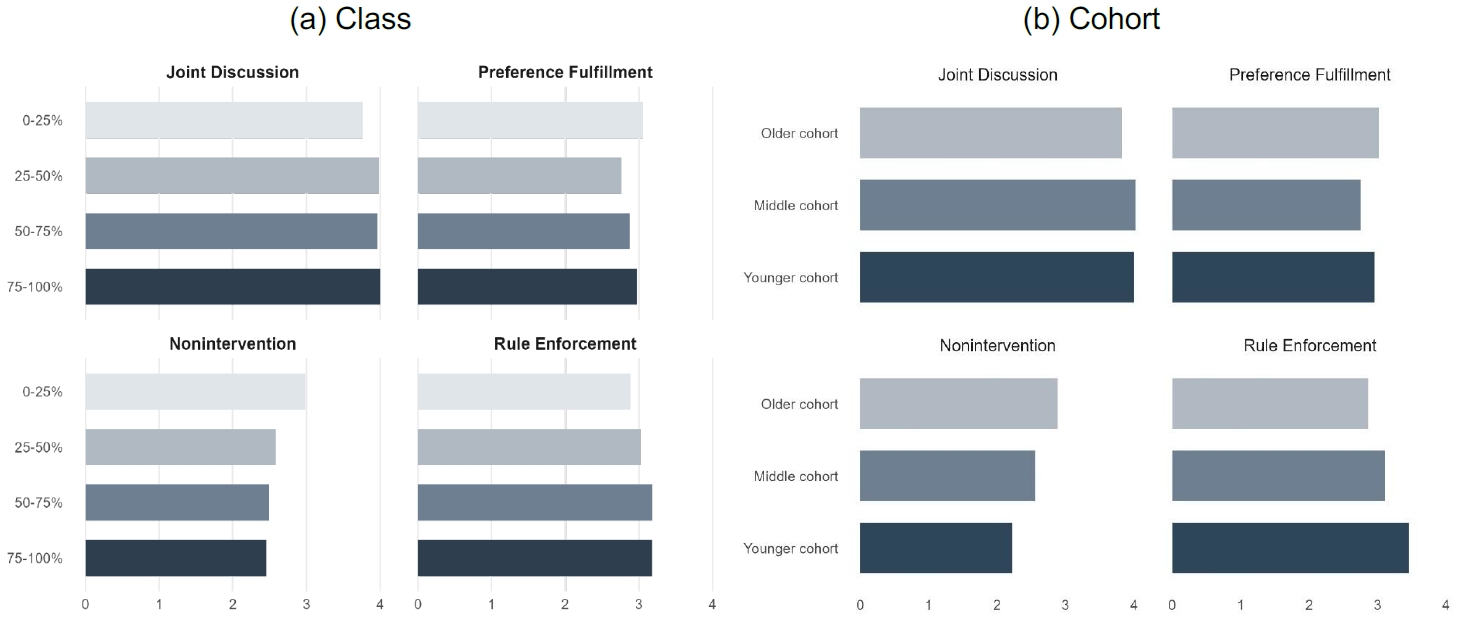
Table 1.Descriptive Statistics (N=978)
Table 1.
|
Variable |
Mean or % |
S.D. |
|
Parenting Attitude Items |
|
|
|
Joint discussion |
3.91 |
0.76 |
|
Preference fulfillment |
2.92 |
1.13 |
|
Nonintervention |
2.67 |
1.08 |
|
Rule enforcement |
3.04 |
1.07 |
|
Class Index |
0.00 |
1.09 |
|
Cohorts |
|
|
|
Older cohort (1926-64) |
52.45 |
|
|
Middle cohort (1965-79) |
30.78 |
|
|
Younger cohort (1980-1999) |
16.77 |
|
|
Female |
59.71 |
|
|
Minnan ethnic group |
78.22 |
|
|
Number of children |
2.34 |
1.00 |
|
Youngest child under 18 (non-retrospective) |
37.53 |
|
|
Parents’ Highest Level of Education |
|
|
|
Junior high school and below |
78.49 |
|
|
Senior high school |
14.07 |
|
|
College or above |
7.44 |
|
|
Residential area |
|
|
|
Metropolitan |
21.57 |
|
|
City |
24.74 |
|
|
Township |
28.32 |
|
|
Rural |
25.36 |
|
Table 2.Ordered Logit Regression Results for Four Parenting Attitude Items (N = 978)
Table 2.
|
Joint Discussion
|
Preference Fulfillment
|
|
Model 1 |
Model 2 |
Model 3 |
Model 4 |
Model 1 |
Model 2 |
Model 3 |
Model 4 |
|
Class index |
.218**
|
|
.206**
|
.188 |
-.072 |
|
-.053 |
-.075 |
|
(.078) |
|
(.079) |
(.099) |
(.066) |
|
(.067) |
(.083) |
|
Cohort (Ref. older cohort) |
|
|
|
|
|
|
|
|
|
Middle cohort |
|
.396 |
.335 |
.337 |
|
-.393*
|
-.376 |
-.371 |
|
|
(.233) |
(.235) |
(.235) |
|
(.198) |
(.199) |
(.200) |
|
Younger cohort |
|
.313 |
.297 |
.292 |
|
-.080 |
-.076 |
.049 |
|
|
(.331) |
(.332) |
(.353) |
|
(.282) |
(.282) |
(.300) |
|
Interaction (Ref. older cohort) |
|
|
|
|
|
|
|
|
|
Class index x Middle cohort |
|
|
|
.039 |
|
|
|
.132 |
|
|
|
|
(.162) |
|
|
|
(.140) |
|
Class index x Younger cohort |
|
|
|
.057 |
|
|
|
-.150 |
|
|
|
|
(.229) |
|
|
|
(.196) |
|
Female |
.667***
|
.591***
|
.648***
|
.646***
|
-.551***
|
-.525***
|
-.538***
|
-.548***
|
|
(.152) |
(.151) |
(.153) |
(.153) |
(.127) |
(.126) |
(.127) |
(.128) |
|
Non-Minnan ethnicity |
-.105 |
-.092 |
-.113 |
-.107 |
-.360*
|
-.351*
|
-.346*
|
-.352*
|
|
(.176) |
(.176) |
(.176) |
(.177) |
(.152) |
(.153) |
(.153) |
(.154) |
|
Number of children |
-.118 |
-.132 |
-.095 |
-.098 |
-.008 |
-.019 |
-.028 |
-.028 |
|
(.080) |
(.081) |
(.082) |
(.082) |
(.069) |
(.069) |
(.070) |
(.071) |
|
Youngest child under 18 |
.415*
|
.262 |
.190 |
.181 |
-.231 |
-.092 |
-.076 |
-.128 |
|
(.171) |
(.253) |
(.255) |
(.259) |
(.145) |
(.218) |
(.219) |
(.224) |
Table
|
Rule Enforcement
|
Nonintervention
|
|
Model 1 |
Model 2 |
Model 3 |
Model 4 |
Model 1 |
Model 2 |
Model 3 |
Model 4 |
|
Parents’ Highest Level of Education (Ref. junior high school and below) |
|
Senior high school |
.326 |
.236 |
.259 |
.251 |
-.338 |
-.375 |
-.273 |
-.268 |
|
(.188) |
(.191) |
(.193) |
(.194) |
(.203) |
(.206) |
(.209) |
(.208) |
|
College or above |
.252 |
.117 |
.173 |
.187 |
-.244 |
-.425 |
-.185 |
-.155 |
|
(.258) |
(.251) |
(.261) |
(.262) |
(.273) |
(.265) |
(.276) |
(.277) |
|
Residential area (Ref. township) |
|
Metropolitan |
.012 |
.004 |
.013 |
.017 |
.142 |
.097 |
.140 |
.150 |
|
(.177) |
(.177) |
(.177) |
(.177) |
(.186) |
(.185) |
(.186) |
(.186) |
|
City |
.028 |
.019 |
.025 |
.036 |
-.218 |
-.238 |
-.217 |
-.223 |
|
(.172) |
(.172) |
(.172) |
(.172) |
(.180) |
(.179) |
(.180) |
(.180) |
|
Rural area |
.178 |
.216 |
.202 |
.206 |
.329 |
.375* |
.316 |
.313 |
|
(.171) |
(.171) |
(.172) |
(.172) |
(.178) |
(.177) |
(.178) |
(.178) |
|
Cut1 |
-3.526***
|
-3.645***
|
-3.655***
|
-3.651***
|
-3.460***
|
-3.335***
|
-3.410***
|
-3.420***
|
|
(.280) |
(.290) |
(.290) |
(.290) |
(.281) |
(.288) |
(.290) |
(.291) |
|
Cut2 |
-.254 |
-.363 |
-.371 |
-.364 |
-.010 |
.103 |
.054 |
.058 |
|
(.237) |
(.246) |
(.246) |
(.246) |
(.244) |
(.254) |
(.255) |
(.255) |
|
Cut3 |
-.148 |
-.256 |
-.265 |
-.258 |
.100 |
.213 |
.164 |
.168 |
|
(.236) |
(.245) |
(.246) |
(.246) |
(.244) |
(.254) |
(.255) |
(.255) |
|
Cut4 |
2.483***
|
2.380***
|
2.372***
|
2.383***
|
3.269***
|
3.362***
|
3.335***
|
3.337***
|
|
(.264) |
(.272) |
(.272) |
(.272) |
(.310) |
(.318) |
(.319) |
(.319) |
REFERENCES
- Bollen, K. A., Glanville, J. L., & Stecklov, G. (2007). Socio-economic status, permanent income, and fertility: A latent-variable approach. Population Studies, 61(1), 15–34. https://doi.org/10.1080/00324720601103866
- Bornstein, M. H., Putnick, D. L., & Lansford, J. E. (2011). Parenting attributions and attitudes in cross-cultural perspective. Parenting, 11(2-3), 214–237. https://doi.org/10.1080/15295192.2011.585568
- Chang, K.-S. (2010). South Korea under compressed modernity: Familial political economy in transition. Routledge.
- Chen, C. L., & Chen, L. C. (2021). The impact of higher education expansion on the educational wage premium in Taiwan: 1985 to 2015. International Journal of Financial Studies, 9(3), 38. https://doi.org/10.3390/ijfs9030038
- Conger, R. D., & Donnellan, M. B. (2007). An interactionist perspective on the socioeconomic context of human development. Annual Review of Psychology, 58(1), 175–199. https://doi.org/10.1146/annurev.psych.58.110405.085551
- Coronil, F. (1997). The magical state: Nature, money, and modernity in Venezuela. University of Chicago Press.
- Duncan, G. J., Daly, M. C., McDonough, P., & Williams, D. R. (2002). Optimal indicators of socioeconomic status for health research. American Journal of Public Health, 92(7), 1151–1157.
- Faircloth, C. (2023). Intensive parenting and the expansion of parenting. In E. Lee J. Bristow C. Faircloth & J. Macvarish (Eds.), Parenting culture studies (pp. 33–67). Springer International Publishing.
- Fung, J., Kim, J. J., Jin, J., Wu, Q., Fang, C., & Lau, A. S. (2017). Perceived social change, parental control, and family relations: A comparison of Chinese families in Hong Kong, Mainland China, and the United States. Frontiers in Psychology, 8, Article 1671. https://doi.org/10.3389/fpsyg.2017.01671
- Hays, S. (1996). The cultural contradictions of motherhood. Yale University Press.
- Hodge, R. W., & Treiman, D. J. (1968). Class identification in the United States. American Journal of Sociology, 73(5), 535–547.
- Holden, G. W., & Edwards, L. A. (1989). Parental attitudes toward child rearing: Instruments, issues, and implications. Psychological Bulletin, 106(1), 29.
- Ishizuka, P. (2019). Social class, gender, and contemporary parenting standards in the United States: Evidence from a national survey experiment. Social Forces, 98(1), 31–58. https://doi.org/10.1093/sf/soy107
- Ishizuka, P. (2025). Parental self-evaluations by gender and social class: Shared parenting ideals, male breadwinner norms, and mothers’ higher evaluation standards. Social Science Research, 128, 103156. https://doi.org/10.1016/j.ssresearch.2025.103156
- Kobakhidze, M. N., Ma, Y., & Tsaloukidis, A. (2024). Tiger parenting beyond cultural essentialism: Discourses of class, culture, and competition in Hong Kong. ECNU Review of Education, 7(3), 531–553. https://doi.org/10.1177/20965311231198252
- Kohn, M. L. (1969). Class and conformity: A study in values. Dorsey Press.
- Kohn, M. L. (1976). Social class and parental values: Another confirmation of the relationship. American Sociological Review, 41(3), 538–545.
- Lan, P. -C. (2014). Compressed modernity and glocal entanglement: The contested transformation of parenting discourses in postwar Taiwan. Current Sociology, 62(4), 531–549. https://doi.org/10.1177/0011392114524509
- Lan, P.-C. (2019). Struggling to raise children: Globalization, parental anxieties and unequal childhoods [In Chinese]. Springhill Publishing.
- Lareau, A. (1987). Social class differences in family-school relationships: The importance of cultural capital. Sociology of Education, 60(2), 73–85.
- Lareau, A. (2003). Unequal childhoods. University of California Press.
- Lee, T. T.-L. (2023). Social class, intensive parenting norms and parental values for children. Current Sociology, 71(6), 964–981. https://doi.org/10.1177/00113921211048531
- Lee, H., & Han, J.-W. (2021). Analysis of parenting attitude types and influencing factors of Korean parents by using latent transition analysis. International Journal of Environmental Research and Public Health, 18(14), 7394. https://doi.org/10.3390/ijerph18147394
- Lin, W.-Y., & Wang, C.-W. (1995). Chinese parental beliefs about childrearing: Strict discipline or corporal punishment? [In Chinese. Indigenous Psychological Research in Chinese Societies, 3, 2–92.
- Martin, P., Halverson, C. F., Wampler, K. S., & Hollett-Wright, N. (1991). Intergenerational differences in parenting styles and goals. International Journal of Behavioral Development, 14(2), 195–207.
- McLanahan, S., & Percheski, C. (2008). Family structure and the reproduction of inequalities. Annual Review of Sociology, 34(1), 257–276. https://doi.org/10.1146/annurev.soc.34.040507.134549
- Prickett, K. C., & Augustine, J. M. (2021). Trends in mothers' parenting time by education and work from 2003 to 2017. Demography, 58(3), 1065–1091. https://doi.org/10.1215/00703370-9160022
- Randles, J. (2021). Willing to do anything for my kids: Inventive mothering, diapers, and the inequalities of carework. American Sociological Review, 86(1), 35–59. https://doi.org/10.1177/0003122420977480
- Shih, Y.-P. (2019). Parenting in three-generation Taiwanese families: The dynamics of collaboration and conflicts. In S. L. Blair & R. P. Costa (Eds.), Transitions into parenthood: Examining the complexities of childrearing (pp. 231–256). Emerald Publishing Limited.
- Shih, Y.-P., & Yi, C.-C. (2014). Cultivating the Difference: Social Class, Parental Values, Cultural Capital and Children's After-School Activities in Taiwan. Journal of Comparative Family Studies, 45(1), 55–76.
- Thornton, A., & Lin, H. S. (1994). Social change and the family in Taiwan. University of Chicago Press.
- Tourangeau, R., & Rips, L. J. (2000). The psychology of survey response. Cambridge University Press.
- Trifan, T. A., Stattin, H., & Tilton-Weaver, L. (2014). Have authoritarian parenting practices and roles changed in the last 50 years?. Journal of Marriage and Family, 76(4), 744–761. https://doi.org/10.1111/jomf.12124
- Yi, C.-C. (2019). Changing Taiwanese families: Research concerns of family sociologists [In Chinese]. Research on Women in Modern Chinese History / Jindai Zhongguo Funu Shi Yanjiu, 34, 219–254.
- Vincent, C. (2001). Social class and parental agency. Journal of Education Policy, 16(4), 347–364. https://doi.org/10.1080/0268093011-54344
- Wu, C.-Y., & Gao, M.-Y. (1997). Intergenerational transmission of harsh parenting [In Chinese]. In L.-Y. Chang Y.-H. Lu & F.-C. Wang (Eds.), Taiwanese society in the 1990s: Taiwan social change survey symposium series II Vol. 2:(pp. 215–247). Institute of Sociology, Academia Sinica.
- Wu, M.-Y. (2016). The challenges of parenting: A sociological analysis of adolescent parenting in Taiwan [In Chinese]. Wunan Publishing.
- Zelizer, V. A. (1994). Pricing the priceless child: The changing social value of children. Princeton U niversity Press.