Abstract
While a growing body of research has emphasized the role of state-granted legitimacy in shaping public acceptance of complementary and alternative medicine (CAM), less is known about why public views of CAM may remain heterogeneous even when it receives official endorsement. We address this question by highlighting the importance of user experience, using Chinese mainland as a case study. Chinese medicine (CM) is a well-known form of CAM that is deeply embedded in China’s healthcare system, supported by extensive infrastructure and strong policy backing. Drawing on in-depth interviews about people’s use of CM for self-treatment and rehabilitation after COVID-19, we find that “lived efficacy”, a subjective evaluation of effectiveness grounded in personal experience, plays a salient role in health-related decision-making. Individuals with positive prior experiences of CM tend to rely less on external information and often differentiate among various forms of CM, including state-endorsed products and folk practices. By contrast, those without such lived efficacy are more likely to adopt state-endorsed CM remedies based on trusted health information sources, such as government messaging. This study contributes to the literature by showing that the effects of state-granted legitimacy and institutional trust on CAM adoption are conditional and mediated by a multidimensional decision-making process. Lived efficacy and information trust constitute two key mechanisms through which respondents interpret the efficacy-based legitimacy of CM.
-
Keywords: Complementary and Alternative Medicines (CAMs); Chinese Medicine (CM); Lived Efficacy; Information Trust; COVID-19
Introduction
Complementary and alternative medicines (CAMs) are medical products and therapies that fall outside mainstream healthcare offerings. Since the latter half of the 20th century, CAM use among the public has exploded, with prevalent use in chronic disease treatments in North America and Australia, nearly 40% amongst cancer patients in Europe, and 88% use amongst World Health Organization (WHO) Member States (
Lee et al., 2022;
WHO, 2019). CAM has also gained popularity in curing infectious disease as individuals exposed to uncertainties are more likely to use CAMs as self-care measures in order to mitigate risks and better manage their health. A growing body of literature highlights CAM use against the threat of new and emerging infectious diseases such as HIV/AIDS, COVID, and H1N1 (
Arora et al., 2011;
Badakhsh et al., 2021;
Lorenc & Robinson, 2013).
With such widespread application, public attitudes toward CAM have attracted rising scholarly attention, including a growing claim that public acceptance depends largely on institutional legitimacy (
Bicho et al., 2023;
Liu et al., 2013). This claim is reflected in policy narratives that continuously emphasize the importance of legal recognition, professionalization, and the integration of CAM into the mainstream healthcare system (
WHO, 2019). At the same time, sociological research has started to incorporate government endorsement as a key variable in explaining the social inclusion of CAMs (
Chen, 2012;
Kelner et al., 2004). These studies suggest that government endorsement may shift CAM from a marginal status toward widespread recognition by signaling credibility and reducing perceived risk for potential users. However, claims of strengthening CAM’s legitimacy often appear in settings where CAM remains outside mainstream healthcare traditions (
Bicho et al., 2023;
Dodworth & Stewart, 2022). It is less clear whether legitimacy can explain healthcare choices in settings where CAM practice is popular and has already been incorporated into state institutions and healthcare service delivery.
In this case, Chinese mainland provides a unique institutional context, characterized by high levels of state-granted legitimacy for Chinese medicine (CM).
1 Recognized by the
WHO (2022), CM is treated as a crucial component of CAMs. It is a system of medicine based on holistic principles and pattern differentiation (
bianzheng) treatments (
Scheid, 2002; Tian & Zhang, 2024;
Xu & Yang, 2009). In China, CM enjoys a high degree of state support across legal status, medical education, and resource investment. CM practitioners in China are uniquely granted equal and independent status with Western Medicine (WM) practitioners regarding professional rights and promotion opportunities. Since the 1950s, CM has been increasingly incorporated and standardized within state-run medical universities (Tian & Zhang, 2024). By 2020, investment in CM grew the number of public CM hospitals in China to 5,482, with medical insurance covering CM services (
State Council General Office of the People’s Republic of China, 2022).
Despite receiving considerable recognition from the state, CM has remained a subject of controversy in China particularly during the COVID-19 pandemic. From the early stages of the pandemic, Chinese official media and treatment guidelines repeatedly promoted CM remedies, particularly Lianhua Qingwen (蓮花清瘟), a Chinese patent medicine that claimed to address COVID-19 symptoms by clearing excessive heat, removing toxins, and reducing lung inflammation (
People’s Daily Overseas Edition, 2020). Yet such a state endorsement did not bring unanimous public acceptance. Survey-based research has shown that, even under strong governmental support, public attitudes toward CM for COVID-19 control remained controversial (
Lin et al., 2022). These attitudes were shaped by multiple factors, including policy endorsement and trust in different institutions and experts (
Xia et al., 2021;
Zhao et al., 2023). At the same time, debate over Lianhua Qingwen’s effectiveness persisted in both public and professional spheres. While some studies reported positive effects of using Lianhua Qingwen in COVID-19 management (
Peng & Chen, 2021;
Xu et al., 2023), criticisms persisted as its scientific validation remained limited and contested (
Pan et al., 2023). In such a context, two puzzles emerge: (1) In a society where CM has achieved high levels of state-granted legitimacy, why do attitudes toward CM remain heterogeneous? (2) Under crisis conditions, how do other factors (including prior personal experience, trust in health information sources) matter for CM adoption?
In-depth interviews with 32 respondents from 6 provinces, 3 municipalities directly under the central government, and one special administrative region in China reveal that attitudes toward and adoption of CM were frequently explained through lived efficacy, referring to a subjective evaluation of CM treatment effectiveness grounded in lived experience. Respondents who experienced positive CM efficacy are more receptive to using CM during COVID-19, whereas those who experienced adverse effects or did not see obvious improvement are more sceptical. Our study further examines the role of lived efficacy and information trust in converting state-granted legitimacy into the efficacy-based legitimacy of CM. Here, information trust refers to individuals’ perceived credibility and reliability of health-related information sources. Without lived efficacy, the decision to try CM relies on respondents’ trust in various health information, including indirect treatment experiences from close social networks, government messaging, and unofficial online platforms. However, once lived efficacy is gained after using CM, it then becomes an influential factor in shaping trust in CM efficacy. In sum, our findings contribute to the literature by showing that the effects of state-granted legitimacy and institutional trust on CAM adoption are conditional and mediated by a multidimensional decision-making process.
In the following, we first review the literature on the legitimacy of CAM, particularly the institutionalization of CM in China, and how lived efficacy and information trust affect healthcare decision-making, followed by a description of methods and data. Using interview data, we then explore the role of lived efficacy and information trust in shaping the efficacy-based legitimacy of CM.
Literature Review
State-Granted Legitimacy of CM in China
Numerous studies in CAM emphasize the importance of building legitimacy. In medical sociology, legitimacy typically refers to the degree to which a therapy is seen as appropriate, credible, and acceptable within prevailing medical systems (
Gale, 2014). Empirically, legitimacy is often inferred from legal recognition, professional regulation, incorporation into medical education, and integration into healthcare services (
Hollenberg & Muzzin, 2010; Tian & Zhang, 2024). Establishing legitimacy can reduce perceived risks, discipline irregular practice, and align CAM with state capacities for governance. Under the influence of this perspective, several CAM practices have undergone the process of legitimization (
Shim, 2018). For example, in South Korea, traditional Korean medicine has been institutionalized through a dual medical system, in which Korean medicine and biomedicine operate as two parallel tracks. This institutional arrangement is further reinforced by coverage of Korean medicine services within the National Health Insurance, reflecting state efforts to standardize practice and govern medical pluralism (
Lim, 2013).
Sociological research generally links the legitimacy of CAM to public trust (
Bicho et al., 2023). The regulation and professionalization of CAM are presumed to cultivate social inclusion by stabilizing standards, credentialing expertise, and providing channels of accountability (
Saks, 1996). In settings where CAM has historically been “outside” the mainstream, state endorsement is likely to change the social position of a therapy, moving it from “folk” to “authorized”, and from unorthodox to orthodox medical knowledge (Carlessi, 2024). In this way, much of the literature frames official governance and promotion as policy recommendations, calling for more institutional guidance on CAM practices (Olsson et al., 2022;
Turavinina & Amornkitvikai, 2025). What remains to be answered, however, is whether institutional guarantees can lead to greater public trust once CAM is already institutionalized in the healthcare system. China, in this case, serves as a valuable empirical setting.
Since the establishment of the People’s Republic of China in 1949, the state has consistently supported CM for public health and cultural reasons (
Scheid, 2002). Rather than a “two-track” system that independently implements CM and biomedicine, China is characterized by what
Shim (2018) terms “interpenetrative pluralism”. In this plural medical system, CM and biomedicine are recognized as equivalent systems yet incorporate each other across multiple sites of professional practice. Under such an arrangement, CM is accorded a high level of state-granted legitimacy. CM doctors and integrative CM-WM doctors are licensed and recognized within China’s national laws and regulations. Such legal recognition extends to practice jurisdiction, with a blurred boundary between WM and CM (Tian & Zhang, 2024). CM-specialized hospitals frequently deliver biomedical services, too, and nearly 90% of biomedical hospitals provide CM services through dedicated departments (
Peng & Chen, 2021). The institutionalization of CM was further reinforced throughout the 2000s when China’s national health insurance system progressively extended healthcare financing to CM (
Nie et al., 2023). In sum, CM in China represents a distinctive case of high state-granted legitimacy.
Yet institutional recognition does not automatically translate into what we call efficacy-based legitimacy, that is, the degree to which CM is considered credible because it is perceived as therapeutically effective. Existing research suggests that CM’s efficacy-based legitimacy remains contested in China for two primary reasons (Tian & Zhang, 2024). First, scholars argue that CM theories are largely seen as conflicting with positivist epistemology (
Hollenberg & Muzzin, 2010; Keshet et al., 2013). Its methodology, diagnostic tools, and individualized treatment plans are difficult to validate or measure through scientific methods (
Baarts & Pedersen, 2009). Second, studies of institutional arrangements caution that the practice of integrating CM and WM can blur professional boundaries, thereby complicating how “effectiveness” is evaluated (
Ning, 2018;
Xu & Yang, 2009). For instance,
Tian and Zhang (2025) find that integrative therapies may prevent practitioners from observing CM’s effects in a separable way, thus reducing their confidence in CM practice. They also note that boundary blurring can encourage CM practitioners to adopt biomedical routines, potentially distancing treatment from traditional principles. Even in a setting where the state grants CM extensive institutional legitimacy, public trust and acceptance can remain uneven. Much of the existing literature explains this puzzle either at the level of epistemological conflict or institutional design, while giving less attention to how ordinary people interpret state endorsement in their everyday health management. This gap makes it crucial to examine how multiple factors, including experiential judgments and trust in health information sources, jointly shape public willingness to initiate and sustain CM use.
A growing body of research in medical sociology and CAM studies has examined how patients’ lived treatment experiences shape medical decision-making (
Oikkonen et al., 2025;
Sippel et al., 2021). They have found that people often evaluate therapies through direct bodily experience and use such evaluations to inform future treatment choices. Building on this observation, we use the term “lived efficacy” to refer to a subjective evaluation of treatment efficacy grounded in direct bodily experience. Some similar terms include perceived effectiveness, healing experience, and experiential knowledge (
Evans et al., 2007;
Sointu, 2013;
Tian & Zhang, 2022). Compared to these closely related terms, our use of lived efficacy more directly captures the effects as they are felt in the body and evaluated through one’s own lived experience.
This “embodied” mode of evaluation is especially important in CAM contexts, as CAM therapies often involve repeated use, gradual effects, and individualized interpretations of improvement. Users frequently rely on personal experience to decide whether a therapy is worth adopting and continuing (
Kim et al., 2016). For example,
Sointu (2013) found that experiences of feeling cured and a sense of improvement are key motivators of continued CAM use among clients in England. In addition, interviews with Danish CAM users revealed that their purpose of using CAM is to gain more control over their bodies (
Baarts & Pedersen, 2009), even if their symptoms persisted.
When examining CM adoption in China, the role and implications of lived efficacy may exhibit distinctive features. In China, experiential evidence of CM efficacy is generated not only in clinics or households. Rather, CM efficacy is also recognized, disseminated, and amplified within the frameworks of national governance and mainstream healthcare systems (
Ho et al., 2020;
Peng & Chen, 2021). Therefore, when people believe that a CM approach is effective, the resulting experience may be interpreted not only as symptom relief but also as confirmation of CM’s public credibility and institutional legitimacy. In contrast, when people perceive a CM therapy as slow, ambiguous, or poorly matched to their symptoms, it may also link to their assessment of the state’s credibility. Yet, existing research on CM adoption typically treats therapeutic effects as an individual-level perception (
Hung et al., 2023;
Sointu, 2013). What remains underexplored is how experiential judgments become intertwined with evaluations of state credibility and official health messaging. Therefore, this article conceptualizes lived efficacy in the context of CM in China and demonstrates how respondents mobilize both experiential evidence and institutional trust when explaining their attitudes toward CM and their decisions about whether to adopt it.
According to a range of quantitative studies, motives behind CAM adoption vary and correspond to differences in how individuals evaluate and trust specific health information sources, including physicians and biomedical institutions, family and peer networks, and mass media (
van der Schee & Groenewegen, 2010;
Xia et al., 2021). The health belief model further clarifies this dynamic: individuals form attitudes, beliefs, and behaviours based on information from trusted sources (Trübner et al., 2025). In the medical field, network knowledge, institutional trust, and online health information serve as primary trusted sources.
Network knowledge plays an informative role in an individual’s decision to trust CAM. CAM users may sometimes obtain substantial amounts of information from family, friends, and co-workers (
van der Schee & Groenewegen, 2010). Interpersonal contacts create opportunities to ask questions about the therapy, hear perspectives about effectiveness, and judge its trustworthiness (see, for example,
Tian and Zhang 2022).
Trust in government messaging, or institutional trust, is public confidence that authorities will make informed decisions within existing regulations (
Majid et al., 2021;
Wang et al., 2024). This trust significantly shaped public health behaviours during COVID-19. Prior research has demonstrated that public trust in government is a key factor of compliance with pandemic control measures and is linked to higher vaccination rates, broader testing, and lower mortality (
Blair et al., 2017;
Tan et al., 2022;
Yuan et al., 2022). While most studies focus on how institutional trust affects Western medicine-oriented prevention and control measures like vaccination, its impact on attitudes toward alternative therapies has not been well examined. The Chinese government’s robust promotion of TCM during the pandemic (
People’s Daily Overseas Edition, 2020), including ongoing updates to diagnostic guidelines and repeated endorsements of remedies such as Lianhua Qingwen, provides a unique context for examining this relationship.
Recent research also indicates that online health information may influence individuals’ medical decisions (
Turavinina & Amornkitvikai, 2025). Using data from the International Social Survey Programme,
Turavinina and Amornkitvikai (2025) showed that more frequent online information-seeking behaviour is associated with higher CAM use and a stronger belief that CAM is superior to conventional biomedicine. Similarly, a quantitative study among cancer patients in South Korea found that prior online exposure to CAM information was positively associated with subsequent CAM use (
Kim et al., 2023).
Despite growing quantitative evidence on the importance of health information sources, little research has examined how individuals navigate trust across multiple sources when deciding whether to adopt CAM treatments. More importantly, it remains unclear how such information trust intertwines with personal lived efficacy of CAM. Understanding this dynamic is crucial to help identify what measures are needed to promote public adoption of CAMs. We therefore use a qualitative approach to understand the variation in public willingness to use CM during the pandemic, specifically considering (1) how people evaluate CM efficacy through direct bodily experience, and (2) how trust in information sources (close social networks, government messaging, and online platforms) becomes relevant when lived efficacy is limited or uncertain.
Methods and Data
Non-Probability Sampling
Data were obtained from 32 respondents between June 2023 and February 2025. The authors and research assistants used convenience and snowball sampling to recruit the initial respondents through their social networks. These respondents subsequently recommended other eligible participants. Respondents are residents of 10 different provinces, municipalities, and special administrative region, hailing from both northern and southern China, as well as economically developed and underdeveloped regions. Although the number of Chinese medicine hospitals in each province has increased significantly following the 2009 healthcare reform, regional disparities in hospital size and doctor quality persist (
Zhu et al., 2020). Therefore, we include districts with varying levels of CM prevalence to avoid regional bias. All respondents contracted at least one COVID-19 infection after restrictions were lifted in 2022, which meant they could share their accumulated and applied experiential knowledge (
Tian & Zhang, 2025) during self-treatment.
Through the preliminary interviews, we found more pronounced attitudinal variations among middle-aged and elderly groups, who also demonstrated more experience with CM adoption. This aligns with existing research, indicating that these individuals are the primary recipients of CM due to age-related health needs (
Chiu et al., 2021). Consequently, we focused subsequent recruitment on these cohorts. In addition, the range of educational levels (high school to Ph.D.), types of occupation (medical to non-medical), and monthly income levels (420 USD to 3,500 USD) among the respondents ensured that the sample and findings were not biased toward a single socioeconomic group. Detailed information on the respondents is provided in
Appendix Table A.
The interviews adopted a semi-structured approach with both online and offline interactions. Each interview ranged from 45 to 60 minutes and was audio-recorded. Ethics approval for the interviews was obtained from the authors’ university. Before the interviews, the respondents received information about the study’s purpose and provided signed informed consent. The interview questions covered personal experiences with COVID-19 infection, health management practices and reasons for adopting particular practices, perceptions of using CM and WM for treating COVID-19, sources of health information during the pandemic and their respective trust levels, lifestyle changes after the pandemic, and their long-term perceptions and usage patterns of both CM and WM.
The authors expanded the interview questions with five healthcare practitioners to gain a better understanding of their experiences working in hospitals during the pandemic, their rationale for using both CM and WM in their clinical practice, and their views on an integrative treatment approach. Each respondent received a voucher worth 200 RMB (28 USD) as a token of appreciation. The interviews continued until data saturation, with a final sample size of 32 respondents.
Inductive Thematic Analysis
All interviews were transcribed by the authors and two research assistants. Audio recordings and interview transcripts were stored in a password-protected shared folder maintained by the research team. Access was restricted to the authors and authorized research assistants. After data transcription, the first and second authors manually conducted initial coding, which generated approximately 40-50 codes. These codes were then grouped into broader themes through iterative comparison and discussion. Consensus was reached through repeated review of the transcripts. Finally, three core themes are identified and reported in the findings below.
Findings
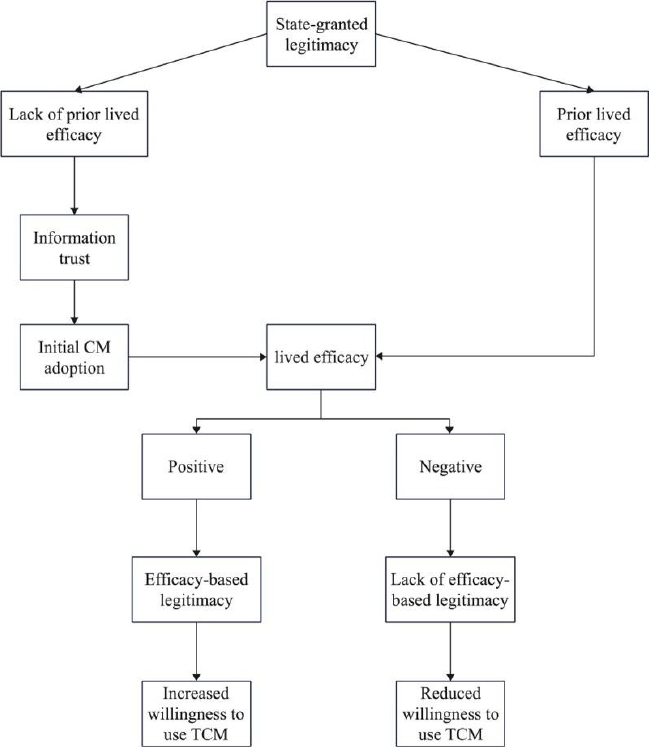
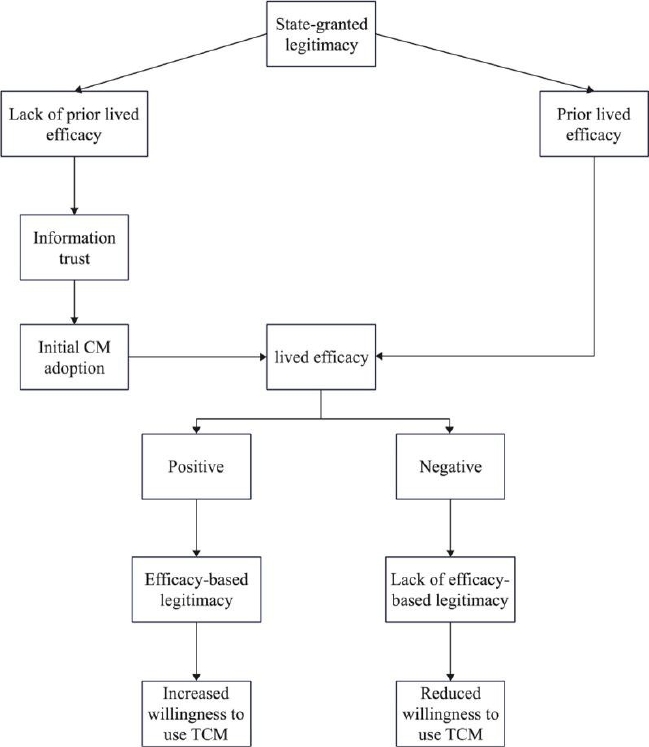
The analysis identified three interrelated themes concerning CM use during the post-COVID-19 period. First, the respondents frequently drew on prior exposure to CM and lived efficacy when explaining their attitudes toward CM. Second, respondents often distinguished among different forms of CM rather than treating it as a single therapeutic category. They also tend to assign varying degrees of trust to each form. Third, when prior CM experience is limited or lived efficacy is difficult to detect, trust in information sources can influence initial use of TCM. These themes and their relationships are summarized in
Figure 1.
Lived efficacy was frequently invoked when respondents explained their use and acceptance of CM. Respondents with habitual or successful prior use were more likely to choose CM for COVID-19, as past recovery process reinforced their medication preferences. One respondent recalled that when he was a child, his parents would treat his colds with Chinese medicinal ingredients such as honeysuckle, and his symptoms would resolve quickly. As a result, he became a firm believer in CM and, during COVID-19, chose CM as his primary treatment method, resorting to WM only when CM proved ineffective:
I believe CM is likely effective against COVID. WM only treats the symptoms, not the root cause. Chinese medicine works to eliminate the virus at its source. (50, Male, Guangdong, Foreign trade, High school, 2,100 USD/month)
Although the respondent’s actual use of CM has shown limited effectiveness in treating COVID- 19, he remained an ardent supporter and attributed the lack of efficacy to other factors, such as insufficient dosage and the poor quality of the herbs. Overall, he emphasized that his experience during COVID-19 “should not be used to negate the efficacy of CM”.
Some respondents had positive experiences when taking CM to treat COVID-19, and those who experienced complex symptoms and long COVID (see
Gorna et al. 2021) were stronger advocates for CM efficacy. Since long COVID remains challenging to cure through biomedical means (
Gorna et al., 2021;
Rushforth et al., 2021), different treatment options are sought, including alternative therapies. In our interviews, some respondents indicated that using WM failed to alleviate their long COVID symptoms, so they took the initiative to try Chinese medicine:
I tried TCM for over two months. It helped to relieve my cough. I started with small doses and gradually increased them… It genuinely had some effect. (57, Male, Guangdong, Teacher/retired, Bachelor’s degree, 1,400 USD/month)
First approaching it as an experiment, this respondent saw continuous improvement in his physical health with an increased dosage, which ultimately led to his confirmation of TCM efficacy.
Similarly, another respondent was sceptical of Da Guo Yao (大锅药, herbal decoction prepared in a large pot) distributed by a local hospital during the early stages of the pandemic. However, after experiencing severe COVID and flu symptoms, she began to use CM-based medicated oil as a preventive measure. Since then, she has found it effective in easing symptoms, and she experienced this effect multiple times. This direct healing experience prompted her to re-evaluate CM:
I believe [Da Guo Yao and medicated oils] share the same underlying principle: they use mild, aromatic herbs to provide a preventive effect. So, in 2023, when my dad told me about the hospitals distributing Da Guo Yao, I was all for it and even reminded him to take it regularly and not skip doses. (28, Female, Yunnan, Student, Master’s degree, 1,300 USD/month)
Conversely, negative evaluations
2 were triggered by a lack of obvious improvement and, in some cases, adverse reactions following CM use (typically subtle side effects). For instance, in our fieldwork, some people reported experiencing diarrhea after taking CM remedies distributed by local authorities during the pandemic. This side effect led them to conclude that CM was unsuitable for COVID treatment. Similarly, in the interviews, several respondents described uncomfortable reactions and perceived no obvious improvement after taking Lianhua Qingwen. One interviewee expressed that there was a mismatch between Lianhua Qingwen and his body conditions:
When I was a child and had a cold, I took Lianhua Qingwen and it did not work for me. I felt this medicine did not match my body conditions. It’s especially ‘cold’ (han).
3 I know my body tends to be ‘cool,’ so I did not dare take it again. (53, Male, Shandong, Teacher, Bachelor’s degree, 1,000 USD/month)
The respondent’s prior uncomfortable experience exacerbated his distrust, contributing to his skepticism and rejection of CM for COVID-19 management.
Distinguishing Different Forms of TCM
Our interviews showed that lived efficacy influenced not only respondents’ attitudes toward CM but also their tendency to distinguish among different forms of CM. For instance, respondents with positive experiences clearly distinguished between state-endorsed proprietary Chinese medicines and folk TCM practices, leading to varying assessments of their credibility:
I consider state-endorsed CMs, primarily Lianhua Qingwen, to be a more “scientific” version of CM. In contrast, I tend to trust independent folk TCM practitioners more. I feel they have more autonomy and independent knowledge systems. (28, Female, Yunnan, Student, Master’s degree, 1,300 USD/month)
Additionally, this tendency of distinguishing between different forms of CM is more pronounced among healthcare professionals, who have personally experienced the efficacy of CM in both their work and daily lives:
Since we also study TCM as a required course, I have some understanding of it… I do not consider Lianhua Qingwen to be traditional Chinese medicine—it is just a product. I am pretty sceptical about its role in treating the virus. (26, Female, Beijing, Medical student [Oral and Maxillofacial Surgeon], Ph.D., 2,100 USD/month)
[Lianhua Qingwen] is a product that the pharmaceutical company uses to make money. Although it contains CM ingredients, its profit-driven model is essentially the same as that of Western pharmaceuticals. (24, Female, Beijing, Medical student [Chinese Medicine], Master’s degree, 420 USD/month)
This distinction is sociologically important since the efficacy of one form does not automatically legitimate all others. In a context where CM is highly institutionalized, individuals may develop differing attitudes toward state-promoted CM healthcare and localized and unofficial CM practices. This finding challenges the narrative emphasizing the sole importance of state-endorsement in healthcare decision-making. It implies that when people gain substantial therapeutic experiences with CM, they differentiate among varying forms rather than simply accept or reject CM as a single, state-driven subject.
A More Complex Decision-Making Process when Lacking Lived Efficacy
It is worth noting that direct exposure to CM did not necessarily produce efficacy-based legitimacy. Sometimes, the combined use of CM and WM can make it difficult to determine the real efficacy of CM. Indeed, in our interviews, many respondents described an attribution problem when CM was used alongside WM or other supplements. A recent study by
Tian and Zhang (2025) has shown that institutional arrangements in Chinese mainland undermine the perceived efficacy of CM among medical professionals. Our research provides complementary evidence that the combined use of CM and WM could undermine recognition of CM efficacy among patients.
For example, a respondent sought relief from COVID-19 by taking protein supplements and Lianhua Qingwen, which “might have made my throat feel slightly better, but I could not tell if it [Lianhua Qingwen] actually worked” (25, Male, Beijing, Student, Ph.D., 420 USD/month). Similarly, another respondent took Western medicine and Ganoderma spore powder (Lingzhi Baozifen, a TCM component) during her COVID infection. She referred to the latter as a “placebo” and admitted that she took it only because she believed there were no side effects; however, she remained sceptical about the ability of CM to treat COVID:
Few people I know relied solely on CM to treat COVID-19… Maybe herbal medicine can help to improve respiratory function, but not when it comes to eradicating viruses. (26, Female, Beijing, State-owned enterprise clerk, Master’s degree, 1,000 USD/month)
When lived efficacy is lacking, respondents’ medical decision-making processes become more complex and contingent. In such cases, information trust serves as a key mechanism through which people decide whether to initiate CM use. Our interviews revealed three health information sources that respondents actively evaluate and compare: indirect treatment experiences from close social circles, government messaging, and unofficial online platforms.
First, close social networks often function as a substitute for direct personal evidence. By witnessing the recovery process of other COVID patients, some respondents translated abstract claims about CM into credibility, increasing their willingness to try CM in the future. A respondent tried using CM during the pandemic but only experienced improvement through WM. Nevertheless, she remained convinced of CM efficacy. The primary reason was that she had witnessed positive outcomes among her classmates:
I have a classmate… Her symptoms [of bronchitis] were similar to mine, but more severe. She recovered by taking TCM. She took the medicine for about two months, and her symptoms improved significantly. If my throat acts up again this summer, I might see the doctor she recommended. (52, Female, Inner Mongolia, Teacher, Bachelor’s degree, 1,100 USD/month)
This similar logic appeared in another case. After contracting COVID-19, the respondent used both CM and WM simultaneously. As a result, she found it difficult to discern the therapeutic effects of CM. However, after witnessing the recovery process of her colleague, she confirmed the effectiveness of CM:
After COVID, [my colleague] had severe bronchial asthma. She tried many treatments—both Western and Chinese medicines—but ultimately chose herbal medicine. Now, her attacks have decreased from 3 to 4 times a year to just 1 to 2 times. Even during flu season, she did not get the flu due to her consistent use of Chinese medicine. (39, Female, Tianjin, Engineer, Bachelor’s degree, 1,100 USD/month)
These cases highlight the important role of close social networks in reinforcing perceptions of CM efficacy. When direct treatment experience fails to provide sufficient evidence, the respondents are more likely to seek out indirect experiences from others as a crucial information source.
Apart from trust in social circles, government messaging also influenced whether individuals were willing to initiate CM use. Previous studies have shown that institutional trust significantly influences personal health management behaviour during public health crises (
Blair et al., 2017;
Tan et al., 2022;
Yuan et al., 2022). Similarly, our interviews revealed that, in the absence of experiential evidence, distrust in government messaging was often mobilized as a reason to withhold trial use of state-promoted CM remedies. For example, one respondent reported no CM use during the past five years. Without direct lived efficacy, she presented a strong resistance to CM during the pandemic, largely due to her aversion to the government’s promotion. She cited doubts about the credibility of government-disseminated information:
The information from state media is ideological propaganda. As for overseas news outlets, even though they are not always correct, I can at least see others challenging or questioning them when they make mistakes. However, there is a complete absence of room for doubt [of state media], which leads me to discount its credibility. (26, Female, Beijing, International education institution teacher, Master’s degree, 1,800 USD/month)
In addition to questioning official information, some respondents held negative views on pandemic control measures since they believed these measures defied scientific principles and the public interest:
The lockdown just did not make sense. They sealed off our compound even though the neighboring block had no COVID cases, and we could not even buy vegetables outside. (52, Female, Hebei, Logistics, High school, 450 USD/month)
These respondents’ scepticism about the ability of the state to make scientific decisions extended to their objection to CM. When the government promoted CM to treat COVID, they argued that the side effects were not known and it had not been clinically tested. Some respondents also suspected that the promotion of certain CM products was entangled with commercial interests (26, Female, Beijing, Business analyst, Master’s degree, 2,800 USD/month), which further undermined their willingness to try state-endorsed remedies.
On the other hand, trust in government messaging could serve as a channel to facilitate CM adoption. Some respondents noted that their longtime awareness of Lianhua Qingwen did not evolve into considering it a treatment option until Lianhua Qingwen appeared in official guidelines (57, Male, Inner Mongolia, Teacher, College degree, 1,100 USD/month). Importantly, government endorsement did not directly translate into positive attitudes toward CM. Instead, these respondents’ positive attitude was established after they had gained lived efficacy from using CM:
At that time, our government recommended several Chinese medicines. I tried Lianhua Qingwen, and it really worked. It felt incredibly comfortable after taking it. If you were suffering from a high fever, feeling stifled and uneasy, taking it would bring a cooling sensation that was extremely soothing. (55, Female, Hebei, Teacher, High school, 500 USD/month)
Similarly, a CM practitioner working in a nursing home observed that after COVID-19, the elderly have a higher demand for and acceptance of Chinese medicine, even among those who previously rarely resorted to CM therapies. She explained the reasons for this change:
I think it depends largely on the guidance of state promotion. Once these [promotional news] were released, people began to demand Chinese medicine, and when it proved effective, acceptance grew naturally. (58, Female, Tianjin, Doctor [Chinese medicine], Bachelor’s degree, 2,000 USD/month)
This pattern illustrates that institutional trust, or trust in government messaging, can enable CM adoption. However, its efficacy-based legitimacy is consolidated through subsequent lived efficacy, instead of external information.
Additionally, several respondents also resorted to unofficial online platforms, such as Xiaohongshu (Little RedNote), as part of their decision-making process. After the relaxation of the pandemic control, treatment experiences became widely circulated online. One respondent reported that she mainly relied on Xiaohongshu for seeking health information, especially when formal medical resources were scarce:
I mainly used Xiaohongshu [to obtain information]. At that time, I read on Xiaohongshu that Lianhua Qingwen was considered effective, so I took it for a day. However, they said you should not mix this kind of medicine with Western medicine… so I thought I should not take so many drugs, and I stopped taking Lianhua Qingwen. (26, Female, Beijing, Business analyst, Master’s degree, 2,800 USD/month)
Taken together, these findings suggest that, lacking prior lived efficacy, their medical decisions are shaped through a more multidimensional process. Information trust shaped how respondents evaluated and mobilized different sources when considering CM adoption. However, only after experiencing efficacy can these respondents reinterpret earlier information as confirmed and acknowledge CM efficacy. In this sense, lived efficacy and information trust operate jointly: information trust opens the pathway to use, while lived efficacy helps build efficacy-based legitimacy.
Conclusion
In response to the widespread use of CM during the pandemic and its promotion by the Chinese government, most existing research has examined the therapeutic efficacy of CM from a biomedical perspective (
Ho et al., 2020;
Ren et al., 2020). Far fewer studies adopt a social science perspective to examine factors shaping attitudes toward CM. Building on findings of substantial variation in CM acceptance (
Pan et al., 2023;
Peng & Chen, 2021), this study explores how lived efficacy and information trust interact to shape such attitudes. Findings of this article reveal that in a plural medical system with high state-granted legitimacy (
Shim, 2018), legitimacy does not automatically translate into acceptance. Instead, people convert institutional endorsement through experiential judgments of efficacy and through selective trust in health information sources, among other considerations. This serves as the most original contribution of this article.
While being cautious of causal interpretation, our findings show that lived efficacy is pivotal to building trust in CM. Respondents who experienced noticeable efficacy of CM were more inclined to use it during the pandemic, whereas those lacking obvious improvement tended to express scepticism toward future CM use. Crucially, among people who experienced positive efficacy, they exhibited a tendency to distinguish between government-endorsed CM products and folk practices, assigning different levels of trust to each. This finding provides direction for improving the future design of quantitative research. While existing surveys have measured “attitude toward CM”, they usually define CM as a single subject (
Xia et al., 2021;
Zhao et al., 2023). It might be helpful to specify different forms of CM in order to produce more accurate results.
This study further clarifies the relationship between lived efficacy and information trust. Absent lived efficacy, different information sources, particularly indirect treatment experiences from close social circles, government messaging, and unofficial online platforms, can influence initial use of CM. However, subsequent treatment experiences emerged as an influential factor in shaping longer-term attitudes toward CM among our respondents. Since lived efficacy plays a more direct role, this study challenges the assumption that state-granted legitimacy or institutional trust alone guides health care decisions (
Becker, 1974;
Yuan et al., 2022). It suggests that efficacy-based legitimacy remains the cornerstone of public trust and top-down promotion of health policy is insufficient. Instead, fostering positive and individualized treatment experiences is more likely to sustain public confidence over time.
In decisions related to health, people increasingly rely on their life experience as they realize that medical knowledge can sometimes be detached from personal health conditions (
Frank, 2013;
Oikkonen et al., 2025). For example, previous research explained how mothers mobilize their childrearing experiences to make generic information from doctors effective (
Tian & Zhang, 2022), and how patients with multiple coexisting chronic diseases must rely on their own embodied experiences rather than the single-disease model common in healthcare (
Oikkonen et al., 2025). Building on these findings, our study complements that lived efficacy not only guides patients’ medical decision-making behaviours but also becomes an integral factor influencing their attitudes toward CAM.
Beyond shaping CAM attitudes, lived efficacy also helps explain broader patterns, such as the spread of CM to Western countries. When investigating factors influencing CM promotion, clinical encounters and patient testimonies often outweigh scientific evidence (
World Health Organization, 2022;
Zhan, 2020). For example, the founding president of the American Foundation of Traditional Chinese Medicine was first treated by an acupuncturist for symptoms unresolved by WM; this experience fostered her trust in TCM and inspired her advocacy in the United States (
Zhan, 2020). Our research echoes the importance of such personal experiences in disseminating CAM, emphasizing how lived efficacy shapes trust across healthcare systems. Future comparisons are needed to explore how the role of lived efficacy varies across cultural and institutional contexts.
Notes
Fig. 1.
REFERENCES
- Arora, R., Chawla, R., Marwah, R., Arora, P., Sharma, R. K., Kaushik, V., Goel, R., Kaur, A., Silambarasan, M., Tripathi, R. P., & Bhardwaj, J. R. (2011). Potential of complementary and alternative medicine in preventive management of novel H1N1 flu (Swine flu) pandemic: Thwarting potential disasters in the bud. Evidence-Based Complementary and Alternative Medicine, 2011, Article 586506. https://doi.org/10.1155/2011/586506
- Baarts, C., & Pedersen, I. K. (2009). Derivative benefits: Exploring the body through complementary and alternative medicine. Sociology of Health & Illness, 31(5), 719–733. https://doi.org/10.1111/j.1467-9566.2009.01163.x
- Badakhsh, M., Dastras, M., Sarchahi, Z., Doostkami, M., Mir, A., & Bouya, S. (2021). Complementary and alternative medicine therapies and COVID-19: A systematic review. Reviews on Environmental Health, 36(3), 443–450. https://doi.org/10.1515/reveh-2021-0012
- Becker, M. H. (1974). The health belief model and personal health behavior. Health Education Monographs, 2, 324–473. http://dx.doi.org/10.1177/109019817400200407
- Bicho, M., Nikolaeva, R., & Lages, C. (2023). Complementary and Alternative Medicine legitimation efforts in a hostile environment: The case of Portugal. Sociology of Health & Illness, 45(4), 890–913. https://doi.org/10.1111/1467-9566.13625
- Blair, R. A., Morse, B. S., & Tsai, L. L. (2017). Public health and public trust: Survey evidence from the Ebola Virus Disease epidemic in Liberia. Social Science & Medicine, 172, 89–97. http://dx.doi.org/10.1016/j.socscimed.2016.11.016
- Carlessi, P. C. (2024). Instituting Traditional Medicine: Changes to identity and legitimacy in global health. Social Theory & Health, 22(4), 269–284. https://doi.org/10.1057/s41285-024-00213-6
- Chen, C. H. (2012). Obstacles to integrative medicine: The case of traditional Chinese medicine in Taiwan. East Asia Law Review, 7(3), 449.
- Chiu, W. K. S., Sze, T. O., Yan, L., Cheung, Y. C., & Lee, K. M. (2021). Utilization of Chinese medicine among Hong Kong citizens: Socio-economic background, decision-making process and policy dimension. [香港市民中醫藥使用情況:社經背景、選擇過程與政策面向]. The Education University of Hong Kong. Retrieved July 24, 2025, from https://repository.eduhk.hk/en/projects/%E9%A6%99%E6%B8%AF%E5%B8%82%E6%B0%91%E4%B8%AD%E9%86%AB%E8%97%A5%E4%BD%BF%E7%94%A8%E6%83%85%E6%B3%81%E7%A4%BE%E7%B6%93%E8%83%8C%E6%99%AF%E9%81%B8%E6%93%87%E9%81%8E%E7%A8%8B%E8%88%87%E6%94%BF%E7%AD%96%E9%9D%A2%E5%90%91
- Dodworth, K., & Stewart, E. (2022). Legitimating complementary therapies in the NHS: Campaigning, care and epistemic labour. Health, 26(2), 244–262. https://doi.org/10.1177/1363459320931916
- Evans, M., Shaw, A., Thompson, E. A., Falk, S., Turton, P., Thompson, T., & Sharp, D. (2007). Decisions to use complementary and alternative medicine (CAM) by male cancer patients: information-seeking roles and types of evidence used. BMC Complementary and Alternative Medicine, 7, 25.
- Frank, A. W. (2013). The wounded storyteller: Body, illness & ethics (2nd ed.). University of Chicago Press.
- Gale, N. (2014). The sociology of traditional, complementary and alternative medicine. Sociology Compass, 8(6), 805–822. https://doi.org/10.1111/soc4.12182
- Gorna, R., MacDermott, N., Rayner, C., O’Hara, M., Evans, S., Agyen, L., & Hastie, C. (2021). Long COVID guidelines need to reflect lived experience. The Lancet, 397(10273), 455–457. https://doi.org/10.1016/S0140-6736(20)32705-7
- Ho, L. T., Chan, K. K., Chung, V. C., & Leung, T. H. (2020). Highlights of traditional Chinese medicine frontline expert advice in the China national guideline for COVID-19. European Journal of Integrative Medicine, 36, 101116. https://doi.org/10.1016/j.eujim.2020.101116
- Hollenberg, D., & Muzzin, L. (2010). Epistemological challenges to integrative medicine: An anticolonial perspective on the combination of complementary/alternative medicine with biomedicine. Health Sociology Review, 19(1), 34–56. https://doi.org/10.5172/hesr.2010.19.1.034
- Hung, Y.-L., Leung, S.-S., Chiu, S.-T. P., Li, P.-Y., Kan, A. C.-O., Lo, C.-C., Wong, S.-Y. Z., Luk, S.- L., Lai, C.-L. C., El Helali, A., & Chan, W. W.-L. (2023). Perceptions about traditional Chinese medicine use among Chinese breast cancer survivors: A qualitative study. Cancer Medicine, 12(2), 1997–2007. https://doi.org/ 10.1002/cam4.5046
- Kelner, M., Wellman, B., Boon, H., & Welsh, S. (2004). The role of the state in the social inclusion of complementary and alternative medical occupations. Complementary Therapies in Medicine, 12(2-3), 79–89. https://doi.org/10.1016/j.ctim.2004.09.002
- Keshet, Y., Ben-Arye, E., & Schiff, E. (2013). The use of boundary objects to enhance interprofessional collaboration: Integrating complementary medicine in a hospital setting. Sociology of Health & Illness, 35(5), 666–681. https://doi.org/10.1111/j.1467-9566.2012.01520.x
- Kim, J. S., Kwon, J. H., Rha, S. Y., Lee, S.-C., Chang, Y. J., Kwon, I.-S., You, K. H., & Yoon, H. Y. (2023). Status of using complementary and alternative medicine among patients with cancer in Korea: An online survey of online cancer support groups (KCSG PC21-20. Cancer Research and Treatment, 55(2), 442–451. https://doi.org/10.4143/crt.2022.1483
- Kim, S. H., Shin, D. W., Nam, Y.-S., Kim, S. Y., Yang, H.-K., Cho, B. L., Park, K., Jo, H.-S., Yim, C.- Y., Kam, S., & Park, J.-H. (2016). Expected and perceived efficacy of complementary and alternative medicine: A comparison views of patients with cancer and oncologists. Complementary Therapies in Medicine, 28, 29–36. http://dx.doi.org/10.1016/j.ctim.2016.07.005
- Lee, E. L., Richards, N., Harrison, J., & Barnes, J. (2022). Prevalence of use of traditional, complementary and alternative medicine by the general population: A systematic review of national studies published from 2010 to 2019. Drug Safety, 45, 713–735. https://doi.org/10.1007/s40264-022-01189-w
- Lim, B. (2013). Korean medicine coverage in the National Health Insurance in Korea: Present situation and critical issues. Integrative Medicine Research, 2(3), 81–88. https://doi.org/10.1016/j.imr.2013.06.004
- Lin, Y., Cai, C. Z., Alias, H., Wong, L. P., & Hu, Z. (2022). A cross-sectional survey of self-medication with traditional Chinese medicine for treatment and prevention of COVID-19. Complementary therapies in medicine, 71, 102898. https://doi.org/10.1016/j.ctim.2022.102898
- Liu, C. H., Tang, W. R., Wang, H. M., & Lee, K. C. (2013). How cancer patients build trust in traditional Chinese medicine. European Journal of Integrative Medicine, 5(6), 495–500. https://doi.org/10.1016/j.eujim.2013.08.003
- Lorenc, A., & Robinson, N. (2013). A review of the use of complementary and alternative medicine and HIV: issues for patient care. AIDS Patient Care and STDs, 27(9), 503–510. https://doi.org/10.1089/apc.2013.0175
- Majid, U., Wasim, A., Truong, J., & Bakshi, S. (2021). Public trust in governments, health care providers, and the media during pandemics: A systematic review. Journal of Trust Research, 11(2), 119–141. https://doi.org/10.1080/21515581.2022.2029742
- Nie, H., Han, Z., Nicholas, S., Maitland, E., Huang, E., Chen, Z., Tuo, S., Ma, Z., & Shi, X. (2023). Costs of traditional Chinese medicine treatment for inpatients with lung cancer in China: a national study. BMC complementary medicine and therapies, 23, 5. https://doi.org/10.1186/s12906-022-03819-3
- Ning, A. (2018). Epistemic hybridity: TCM’s knowledge production in Canadian contexts. In C. Brosnan P. Vuolanto & J.-A. Brodin Danell (Eds.), Complementary and alternative medicine: Knowledge production and social transformation (pp. 247–272). Springer International Publishing.
- Oikkonen, V., Helosvuori, E., Ganesh, A., & Rokkonen, L. A. (2025). Entangled illnesses: Embodied experiences of managing multimorbidity. Sociology of Health & Illness, 47, e70006. https://doi.org/10.1111/1467-9566.70006
- Olsson, A., Hedlund, S., & L, gren (2022). To use or not use complementary and alternative medicine (CAM) in psychiatric care: Interviews with clinical decision-makers in Sweden. Issues in Mental Health Nursing, 43(5), 463–472. https://doi.org/10.1080/01612840.2021.1986759
- Pan, B., Yin, H. W., Yu, Y., Xiang, X., Yu, C., Yan, X. J., & Hong, J. (2023). Acceptance and attitude towards the traditional Chinese medicine among asymptomatic COVID-19 patients in Shanghai Fangcang hospital. BMC Complementary Medicine and Therapies, 23, 97. https://doi.org/10.1186/s12906-023-03922-z
- Peng, A. Y., & Chen, S. (2021). Traditional Chinese medicine works: A politicised scientific debate in the COVID-19 pandemic. Asian Journal of Communication, 31(5), 421–435. https://doi.org/10.1080/01292986.2021.1913618
- People’s Daily Overseas Edition (2020, April 17). The “Three Medicines and Three Formulas” of traditional Chinese medicine in epidemic prevention and control [抗疫中的中医药三药三方]. People’s Daily Overseas Edition. http://paper.people.com.cn/rmrbhwb/html/2020-04/17/content_1982360.htm
- Ren, J.-L., Zhang, A.-H., & Wang, X.-J. (2020). Traditional Chinese medicine for COVID-19 treatment. Pharmacological Research, 155, 104743. https://doi.org/10.1016/j.phrs.2020.104743
- Rushforth, A., Ladds, E., Wieringa, S., Taylor, S., Husain, L., & Greenhalgh, T. (2021). Long Covid- the illness narratives. Social Science & Medicine, 286, 114326. https://doi.org/10.1016/j.socscimed.2021.114326
- Saks, M. (1996). From quackery to complementary medicine: The shifting boundaries between orthodox and unorthodox medical knowledge. In B. Broom & R. Cant (Eds.), Complementary and alternative medicines: Knowledge in practice (pp. 27–43). Free Association Books.
- Scheid, V. (2002). Chinese medicine in contemporary China: Plurality and synthesis. Duke University Press.
- Shim, J. M. (2018). Three plural medical systems in East Asia: interpenetrative pluralism in China, exclusionary pluralism in Korea and subjugatory pluralism in Japan. Health Policy and Planning, 33(3), 401–410. https://doi.org/10.1093/heapol/czy001
- Sippel, A., Riemann-Lorenz, K., Scheiderbauer, J., Kleiter, I., Morrison, R., Kofahl, C., & Heesen, C. (2021). Patients experiences with multiple sclerosis disease-modifying therapies in daily life- a qualitative interview study. BMC Health Services Research, 21, 1141. https://doi.org/10.1186/s12913-021-07012-z
- Sointu, E. (2013). Complementary and alternative medicines, embodied subjectivity and experiences of healing. Health, 17(5), 530–545. https://doi.org/10.1177/1363459312472080
- State Council General Office of the People’s Republic of China (2022, March 29). Circular of the General Office of the State Council on issuing the 14th Five-Year Plan for traditional Chinese medicine development [国务院办公厅关于印发“十四五中医药发展规划”的通知]. https://www.gov.cn/zhengce/zhengceku/2022-03/29/content_5682255.htm
- Tan, M., Straughan, P. T., & Cheong, G. (2022). Information trust and COVID-19 vaccine hesitancy amongst middle-aged and older adults in Singapore: A latent class analysis approach. Social Science & Medicine, 296, 114767. https://doi.org/10.1016/j.socscimed.2022.114767
- Tian, X., & Zhang, S. (2022). Expert or experiential knowledge? How knowledge informs situated action in childcare practices. Social Science & Medicine, 307, 115195. https://doi.org/10.1016/j.socscimed.2022.115195
- Tian, X., & Zhang, S. (2025). Legitimacy and professional boundaries: An institutional analysis of Chinese Medicine in Mainland China and Hong Kong. Health, 29(5), 743–762. https://doi.org//10.1177/13634593241303612
- Trübner, M., Patzina, A., Lehmann, J., Brinkhaus, B., Kessler, C. S., & Hoffmann, R. (2025). Health information-seeking behavior among users of traditional, complementary and integrative medicine (TCIM. BMC Complementary Medicine and Therapies, 25, 111. https://doi.org/10.1186/s12906-025-04843-9
- Turavinina, D., & Amornkitvikai, Y. (2025). Internet health information-seeking behavior and the use of traditional and complementary medicine: The role of online engagement and perceived information usefulness and reliability. BMC Complementary Medicine and Therapies, 25, 431. https://doi.org/10.1186/s12906-025-05167-4
- van der Schee, E., & Groenewegen, P. P. (2010). Determinants of public trust in complementary and alternative medicine. BMC Public Health, 10, 128.
- Wang, C., Zhu, J., & Zhang, D. (2024). The paradox of information control under authoritarianism: Explaining trust in competing messages in China. Political Studies, 72(4), 1431–1452. https://doi.org/10.1177/00323217231191399
- World Health Organization (2019). WHO global report on traditional and complementary medicine 2019. https://www.who.int/publications/i/item/978924151536
- World Health Organization (2022). WHO international standard terminologies on traditional Chinese medicine. https://www.who.int/publications/i/item/9789240042322
- Xia, Y., Chang, J. H., Miao, H. Z., & Wang, D. (2021). Impact of the COVID-19 pandemic on intention to use traditional Chinese medicine: A cross-sectional study based on the theory of planned behavior. Journal of Integrative Medicine, 19(3), 219–225. https://doi.org/10.1016/j.joim.2021.01.013
- Xu, J., & Yang, Y. (2009). Traditional Chinese medicine in the Chinese health care system. Health Policy, 90(2-3), 133–139. https://doi.org/10.1016/j.healthpol.2008.09.003
- Xu, Q., Song, K., Clifford, S. P., Kong, M., & Huang, J. (2023). Meta-analysis of traditional Chinese medicine Lianhua Qingwen in the treatment of coronavirus disease 2019. Journal of Anesthesia and Translational Medicine, 2(2), 20–27. https://doi.org/10.58888/2957-3912-2023-06-21
- Yuan, H., Long, Q., Huang, G., Huang, L., & Luo, S. (2022). Different roles of interpersonal trust and institutional trust in COVID-19 pandemic control. Social Science & Medicine, 293, 114677. https://doi.org/10.1016/j.socscimed.2021.114677
- Zhan, M. (2020). Other-worldly: Making Chinese medicine through transnational frames. Duke University Press.
- Zhao, H., Zhang, R., & Chen, Y. (2023). The influencing role of cultural values on attitudes of the Chinese public towards traditional Chinese medicine (TCM) for the control of COVID-19. Patient Preference and Adherence, 17, 3589–3605. https://doi.org/10.2147/PPA.S443713
- Zhu, D., Shi, X., Nicholas, S., & He, P. (2020). Regional disparities in health care resources in traditional Chinese medicine county hospitals in China. PLOS ONE, 15(1), e0227956. https://doi.org/10.1371/journal.pone.0227956
Appendix
Appendix
Table A. Respondent Profiles
Table
|
Sample (n = 32) |
|
Location
|
|
|
Beijing |
9 |
|
Shanghai |
3 |
|
Fujian |
1 |
|
Guangdong |
3 |
|
Hebei |
2 |
|
Hong Kong |
5 |
|
Inner Mongolia |
3 |
|
Shandong |
2 |
|
Tianjin |
2 |
|
Yunnan |
2 |
|
Gender
|
|
|
Female |
18 |
|
Male |
14 |
|
Education level
|
|
|
Secondary education |
4 |
|
Post-secondary non-tertiary |
3 |
|
Bachelor’s degree |
14 |
|
Master’s degree |
8 |
|
Doctorate |
3 |
|
Age (years old)
|
|
|
Under 35 |
12 |
|
35 or above |
20 |
|
Occupation
|
|
|
Medical-related |
5 |
|
Non-medical |
27 |
|
Monthly income (USD)
|
|
|
Less than 1000 |
9 |
|
1000 to 2000 |
12 |
|
2000 and above |
11 |